
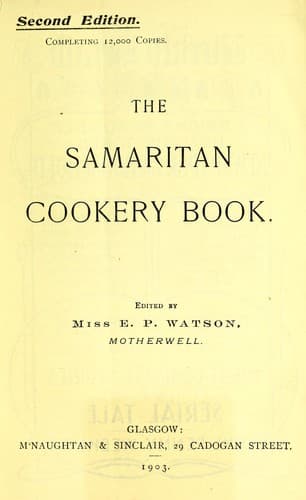
The Samaritan cookery book
1903E. P. Watson · 90 readable pages · 468 recipe records · general household cookbook (charity compilation)
From the librarian's dossier · AI-generated, grounded in the scanned text
The Samaritan Cookery Book (1903) is a charity cookbook compiled by supporters of the Glasgow Samaritan Hospital for Women. Like many fundraising cookbooks of its era, it gathers recipes contributed by named individuals, many with Glasgow addresses, alongside period advertisements from local businesses. Its nearly 470 anchored food records span soups, fish, meat, vegetables, puddings, cakes, breads, sauces, preserves, sweetmeats, and invalid cookery, plus a distinct section of Jewish and Passover recipes near the end. The preface frames the collection within a modern, scientific approach to dietetics, while the seasonal provisions guidance and weights and measures tables signal its practical, household purpose. Readers will find both everyday economical dishes, such as shepherd's pie and fish balls, and more elaborate showpieces like galantines, aspics, and named puddings (Braemar, Samaritan, Victoria). The book also preserves a window into domestic medicine, with recipes for beef tea, gruel, and various home remedies mixed among the food content. This is not a narrative cookbook but a working compilation meant for kitchen use, community fundraising, and record-keeping. Modern readers approaching it today will encounter a snapshot of Scottish urban middle-class household cookery at the turn of the twentieth century, filtered through a charitable and communal lens rather than a single authorial voice.
The book proceeds through broad culinary categories in sequence: front matter and soups (section 1), fish and meat (sections 2 to 3), puddings, custards, and creams (sections 4 to 6), small cakes and invalid cookery (section 7), sauces, preserves, and sweetmeats (section 8), and finally Jewish and Passover recipes, miscellaneous remedies, and an alphabetical index (section 9). Within each section, recipes are grouped by heading and often carry the names and addresses of contributors, indicating a crowd-sourced compilation rather than a single author's continuous text. Advertisements for Glasgow businesses and commercial food products appear interspersed throughout, particularly in sections 4, 8, and 9.
Recipes from this book
468 records extracted from the text, showing the first 50 in reading order. Each links to a modern interpretation.
Read the book
90 readable pages. A dot marks pages with recipe records.