
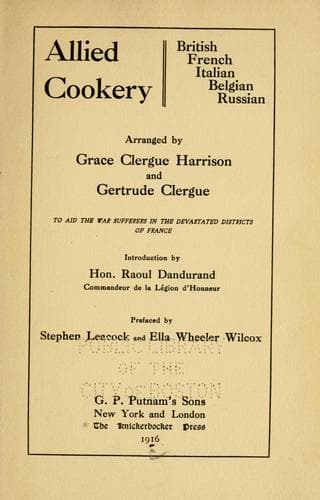
Allied cookery
1916Harrison, Grace Clergue Mrs. · 33 readable pages · 148 recipe records · international charity cookbook
From the librarian's dossier · AI-generated, grounded in the scanned text
Allied Cookery is a 1916 charity cookbook compiled by Grace Clergue Harrison and Gertrude Clergue to raise funds for French war sufferers during the First World War. It gathers recipes from British, Belgian, French, Italian, and Russian kitchens into a single volume, framed by playful prefatory material from Stephen Leacock and Ella Wheeler Wilcox. The book moves through soups, fish, meats and entrees, vegetables, sauces, puddings and cakes, and finally breakfast items, preserves, and beverages. Its recipes range from home-style dishes like nut bread and bran muffins to elaborate formal preparations such as boned turkey glazed with aspic and crepes Suzette. Readers encounter a snapshot of early twentieth-century transnational home cookery, shaped by wartime charitable purpose and by the culinary fashions of the period, including colonial Indian-influenced curries and rice dishes. As a document it is both a practical recipe collection and a piece of wartime cultural history, useful to modern readers interested in period foodways, home front fundraising efforts, and the blending of European culinary traditions in American kitchens of the era.
The book opens with prefatory material, including a statement of purpose and humorous forewords, before organizing recipes roughly by course: soups and fish begin the collection, followed by meats, poultry, game, and entrees, then vegetables, sauces, and salad dressings, then puddings, cakes, and desserts, and finally a closing section of baked goods, breakfast items, preserves, and beverages. Recipes throughout are attributed to specific national cuisines (British, Belgian, French, Italian, Russian, and others) rather than grouped strictly by that origin, so national dishes appear interspersed within each course-based section.
Recipes from this book
148 records extracted from the text, showing the first 50 in reading order. Each links to a modern interpretation.
Read the book
33 readable pages. A dot marks pages with recipe records.