
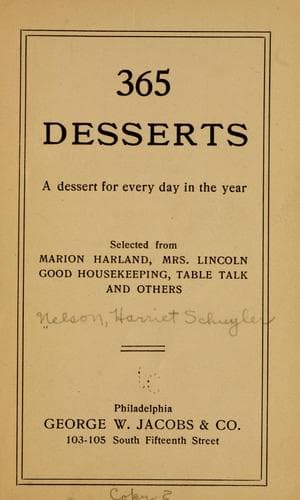
365 desserts
1900Harriet Schuyler Nelson · 57 readable pages · 337 recipe records · calendar-organized dessert cookbook
From the librarian's dossier · AI-generated, grounded in the scanned text
365 Desserts is a calendar-organized dessert cookbook published in 1900 by Harriet Schuyler Nelson, offering one recipe for each day of the year. Rooted firmly in late Victorian American domestic cookery, the book moves month by month from January through December, presenting a steady stream of puddings, pies, custards, molded creams, ices, and frozen confections. The recipes draw heavily on contemporary periodicals such as Table Talk and Good Housekeeping, and cite recognized culinary authorities of the day like Marion Harland and Mrs. Lincoln, situating the book within a network of shared domestic knowledge rather than presenting itself as wholly original. With 337 anchored food records, this is a dense, practical reference intended for daily use in a well-equipped American kitchen of the period. Modern readers will find a vivid record of seasonal eating patterns, from spring fruit desserts to summer ices to autumn spiced puddings and holiday specialties, along with insight into the era's fascination with molding, freezing, and decorative presentation. The book closes with a full alphabetical index, underscoring its intended use as a working reference rather than a narrative cookbook. It offers both a practical resource for historically minded cooks and a window into upper-middle-class American dessert culture at the turn of the twentieth century.
The book is organized as a calendar of desserts, moving sequentially through the months of the year beginning in January and ending in December, with one recipe assigned to each day. This structure spans six sections in the corpus material, each covering a cluster of consecutive months (January-February, March-May, May-July, July-September, October-November, and November-December). Headings throughout mark the month and sometimes subdivide into named days or repeated month labels, suggesting a strict day-by-day layout. The final section closes with an alphabetical index of all recipes in the complete book, indicating the volume was designed for quick lookup as well as sequential reading.
Recipes from this book
337 records extracted from the text, showing the first 50 in reading order. Each links to a modern interpretation.
Read the book
57 readable pages. A dot marks pages with recipe records.