
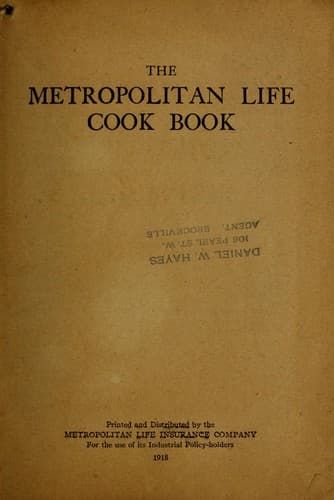
Metropolitan cook book
1918Metropolitan Life Insurance Company · 45 readable pages · 178 recipe records · general household cookbook
From the librarian's dossier · AI-generated, grounded in the scanned text
The Metropolitan Cook Book was published in 1918 by the Metropolitan Life Insurance Company as a household guide for policyholders, intended to promote economical, nutritious home cooking. Rather than a chef's showcase, it is a practical manual grounded in the era's concerns about cost, food value, and efficient housekeeping. It opens with guidance on selecting and storing food economically before moving through breakfast dishes, breads, soups, fish, meats and meat substitutes, vegetables, salads, desserts, and finally cakes, pastries, and pies. Throughout, the emphasis falls on nutrition per dollar spent, proper measurement, and reducing waste through use of leftovers. The book reflects a company mission to educate working and middle-class households on stretching food budgets while maintaining family health, a theme visible in its careful attention to substitute ingredients, meat alternatives like beans and eggs, and detailed cost-conscious instructions. Modern readers will find a window into early twentieth-century domestic economy, written in the plain, instructional style typical of institutional cookbooks of the period. It is less a book of culinary indulgence than one of applied home economics, useful today both as a historical document and as a record of how nutrition and thrift were taught to ordinary American families in the years following World War I.
The cookbook proceeds in a logical meal-and-course sequence: introductory material on food selection, storage, and measurement (section 1); breakfast breads and early bread-making instruction alongside beverages, soups, and fish (section 2); meat cookery, meat substitutes, and vegetable cookery basics (section 3); further vegetable preparations, salads and dressings, and an introduction to desserts (section 4); and cake frostings, fillings, sauces, cookies, and pastry/pie recipes, closing with a detailed index (section 5). Each section groups recipes under clear category headings, with time tables, general rules, and substitution notes interspersed among the recipes themselves.
Recipes from this book
178 records extracted from the text, showing the first 50 in reading order. Each links to a modern interpretation.
Read the book
45 readable pages. A dot marks pages with recipe records.