
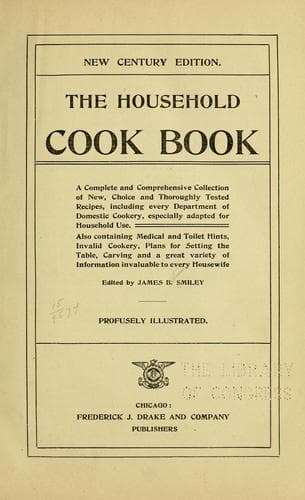
The household cook book
1902Smiley, James B[ethuel], · 482 readable pages · 1,765 recipe records · general household cookbook
From the librarian's dossier · AI-generated, grounded in the scanned text
The Household Cook Book (1902), compiled by James B. Smiley, is a sweeping American domestic cookery manual from the turn of the twentieth century. Presented as a New Century Edition, it aims to serve the average householder with economical, thoroughly tested recipes while also offering elaborate preparations for special occasions. The book opens with nutrition tables, weights and measures, and cooking-time guides before moving through soups, fish and shellfish, sauces, meats, poultry, game, eggs and dairy, vegetables, breads, pastries, puddings, desserts, confectionery, preserving and canning, beverages, invalid cookery, carving, chafing dish cookery, and a substantial block of home medical and toilet remedies. It closes with a French culinary glossary and detailed recipe indices. With over 1,700 anchored food records and a handful of household and medicinal entries, the volume functions as both a kitchen reference and a broader domestic manual, reflecting the era's emphasis on scientific explanation of cooking principles, thrift, and self-sufficient home management. Modern readers will find it a rich window into period foodways, food preservation science, and household medicine, organized for practical daily consultation rather than narrative reading.
The book proceeds from introductory tables and principles (section 1) through soups, fish, and shellfish (sections 3 through 7), sauces and flavored vinegars (sections 8 and 9), meats, poultry, and game (sections 11 through 14), eggs, dairy, and salads (sections 15 through 17), vegetables (sections 19 and 20), breads and breakfast dishes (sections 20 through 23), pastry, pies, and puddings (sections 24 through 26), fried dough, cakes, and confectionery (sections 27 through 35), fruit preservation, canning, and pickling (sections 36 through 41), beverages and invalid cookery (sections 42 through 44), carving and table service (section 45), chafing dish cookery and medical remedies (sections 46 and 47), and a closing glossary with comprehensive indices (sections 48 and 49). Each major food category is preceded by explanatory notes on principles and technique before launching into individual recipes, and the book ends with reference material meant to help readers locate specific dishes.
Recipes from this book
1,763 records extracted from the text, showing the first 50 in reading order. Each links to a modern interpretation.
Read the book
482 readable pages. A dot marks pages with recipe records.