
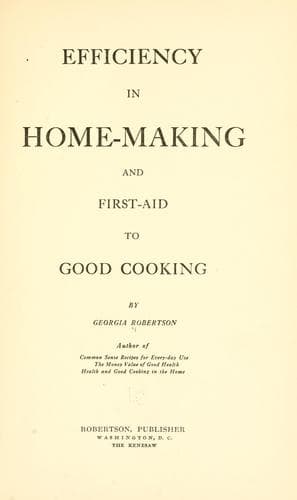
Efficiency in home-making and first-aid to good cooking
1915Robertson, Georgia · 81 readable pages · 126 recipe records · general household management and cookbook
From the librarian's dossier · AI-generated, grounded in the scanned text
Published in 1915, Georgia Robertson's 'Efficiency in Home-making and First-Aid to Good Cooking' is a hybrid manual that blends scientific household management with practical cookery. Rather than a simple recipe collection, it opens with an extended treatise on domestic life, covering house selection, sanitation, water supply, heating, lighting, and the organization of servants' work, before moving into food selection, cooking science, and finally recipes proper. The book reflects the era's fascination with 'efficiency' as a guiding philosophy, applying language borrowed from industrial management to the rhythms of housework, meal service, and kitchen layout. Its recipes, when they appear, are grounded in explanations of technique, heat control, and digestion rather than presented as bare instructions. Readers will find guidance on soups, meats, vegetables, breads, salads, and desserts alongside sections on laundry, household accounts, and moral arguments about alcohol in cooking. This is a book for the modern reader interested less in exotic dishes and more in the texture of early twentieth-century domestic ideology, where cleanliness, thrift, and scientific method were treated as inseparable from good cooking and family health.
The book proceeds from broad household concerns to specific culinary instruction. Section 1 opens with home selection and environmental health (ventilation, water, heating, lighting) before moving into interior arrangement and basic housekeeping routines. Section 2 continues with sanitation, pest control, and kitchen equipment, introducing germ theory as a rationale for cleanliness. Section 3 addresses labor organization, presenting detailed staff schedules and table-setting protocols grounded in efficiency studies. Section 4 covers laundry, household accounts, and moral guidance on alcohol, transitioning toward meal planning and marketing. Section 5 marks the shift into food science proper, covering ingredient selection, stove management, and cooking time tables, followed by Section 6's continuation of cooking principles alongside early recipes for breads, beverages, and cereals. Sections 7 and 8 form the recipe core, organized by category: soups, eggs, meats, fish, vegetables, salads, and desserts. Section 9 is a single index page summarizing the book's full recipe range by category.
Recipes from this book
126 records extracted from the text, showing the first 50 in reading order. Each links to a modern interpretation.
Read the book
81 readable pages. A dot marks pages with recipe records.