
FoodNet
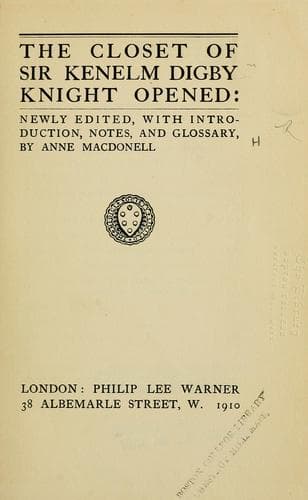
Cover of The closet of Sir Kenelm Digby Knight opened

The closet of Sir Kenelm Digby Knight opened

1910

Sir Kenelm Digby · 162 readable pages · 294 recipe records · seventeenth-century household receipt book (culinary and medicinal), scholarly edition

From the librarian's dossier · AI-generated, grounded in the scanned text

The Closet of Sir Kenelm Digby Knight Opened is a 1910 scholarly edition, prepared by editor Anne MacDonell, of a seventeenth-century English collection of culinary and medicinal receipts attributed to Sir Kenelm Digby (1603-1665), a courtier, natural philosopher, and diplomat. Compiled and published posthumously through his steward Hartman, the work gathers recipes credited to a wide circle of aristocratic and professional contacts, including countesses, lords, physicians, and specialist tradesmen such as the King's meath maker. The bulk of the book concerns brewing honey-based beverages, mead and metheglin, alongside broths, potages, puddings, preserved meats, cheeses, cakes, and fruit preserves. The 1910 edition opens with an extensive editorial introduction situating Digby's life and character, arguing that his culinary and household interests were inseparable from his broader intellectual pursuits in natural philosophy and medicine. Readers encounter a text that blends practical kitchen instruction with period notions of health, digestion, and remedy, reflecting how food, medicine, and domestic management overlapped in aristocratic households of the time. The book offers a window into the ingredients, techniques, and social networks of seventeenth-century English elite cookery, framed by early twentieth-century scholarly commentary that contextualizes Digby's work among contemporaries like The Queen's Closet Opened and Robert May's The Accomplisht Cook.

The book opens with substantial front matter (sections 1-3) consisting of an editorial introduction that covers Digby's biography, his intellectual milieu, and the circumstances of the manuscript's posthumous publication. This transitions into the recipe collection proper, which begins with an extended run of mead and metheglin recipes (sections 3-6) organized largely by contributor name (Lady Gower, Sir Thomas Gower, Lady Morice, Sir William Paston, the Countess of Dorset, and others), each offering variant methods and strengths. Later sections (9, 11-14) shift to broths and potages, cream dishes and syllabubs, meat and game preparations, puddings, pickling and preservation techniques, cheeses, cakes, and fruit preserves. Recipes are grouped by dish type and frequently attributed to named aristocratic or professional sources, with headings drawn directly from the original receipt titles.

This is a historical text reflecting seventeenth-century practices that are not safe or advisable by modern standards, including home fermentation without modern sanitation controls, extended meat storage through pickling and fat-sealing rather than refrigeration, and medicinal remedies (such as treatments for mad dog bites and the falling sickness) mixed directly among the food recipes. The anchored records note only a single medicinal entry, but the section summaries show medicinal and health-directed recipes (broths and potages for the infirm, meath for the liver and lungs) appearing throughout the culinary material, so readers should not treat this purely as a modern cookbook. Measurements are imprecise by modern standards, relying on visual and tactile tests, and archaic terminology may be unfamiliar. As a 1910 transcription of a much older text, some OCR or transcription inconsistencies in spelling and formatting may be present, and the editorial introduction's biographical claims about Digby reflect the 1910 editor's interpretation rather than independently verified fact within this material.

Start reading →

Recipes from this book

294 records extracted from the text, showing the first 50 in reading order. Each links to a modern interpretation.

Metheglin as it is made at Liegep. 23White Metheglin of My Lady Hungerfordp. 24Meathp. 25Excellent Meathep. 25Weaker, but Very Pleasant, Meathep. 26Excellent White Meathep. 26The Countess of Bullingbrook's White Metheglinp. 27Mr. Webbe's Meathp. 28Meathep. 29Sack with Clove-Gilly Flowersp. 32Hydromel with Clove-Gillyflowersp. 32Sir Thomas Gower's Metheglin for Healthp. 33My Lady Gowers White Meathp. 34Sir Thomas Gower's Ordinary Drinkp. 35Metheglinp. 35White Metheglinp. 35Another Way of Making White Metheglinp. 36Strong Meadp. 37Receipt for Making Meadp. 37Meathp. 37My Lord Hollis Hydromelp. 37White Metheglinp. 38Hydromel as I Made It Weak for the Queen Motherp. 38Herbal Meadp. 39Sweet-Bryar Meadp. 40Lady Morice's Meadp. 40To Make White Meathp. 41Sir William Paston's Meathep. 41Another Pleasant Meathe of Sir William Paston'sp. 41Another Way of Making Meathp. 42My Lady Bellassises Meathp. 43Mr. Pierce's Excellent White Metheglinp. 44Good Metheglinp. 47Meathep. 48Lady Vernon's White Metheglinp. 48Several Sorts of Meathp. 48To Make Meathp. 49Sir John Arundel's White Meathp. 49To Make Metheglinp. 50To Make White Meathp. 50To Make a Meath Good for the Liver and Lungsp. 50To Make White Metheglinp. 50White Metheglinp. 51A Most Excellent Metheglinp. 51White Metheglin of the Countess of Dorsetp. 52Another Way to Make White Metheglinp. 52A Receipt to Make Good Meathp. 53To Make Meathp. 53To Make Metheglinp. 54Another Sort of Metheglinp. 54

Browse all 294 records →

Read the book

162 readable pages. A dot marks pages with recipe records.

0123456789101112131415161718192021222324252627282930313233343536373839404142434445464748495051525354555657585960616263646566676869707172737475767778798081828384858687888990919293949596979899100101102103104105106107108109110111112113114115116117118119120121122123124125126127128129130131132133134135136137138139140141142143144145146147148149150151152153154155156157158159160161