
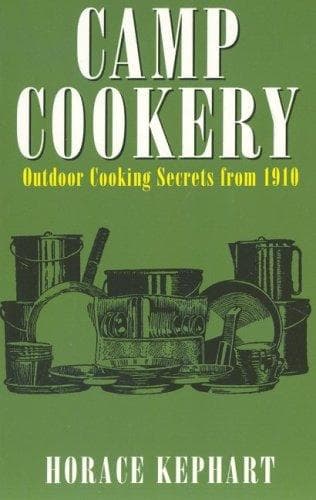
Camp cookery (Kephart)
1910Kephart, Horace · 74 readable pages · 144 recipe records · outdoor and camp cookery manual
From the librarian's dossier · AI-generated, grounded in the scanned text
Camp Cookery is Horace Kephart's 1910 manual for feeding a small party in the backcountry, written for hunters, hikers, and campers who must carry their own provisions and improvise with fire instead of a stove. Rather than a general household cookbook, it approaches cooking as a logistical problem: what to carry, how much it weighs, how it keeps, and how to prepare it with minimal gear. Kephart works methodically through provisioning and ration planning, equipment selection, fire building and fuel choice, the dressing and preservation of game and fish, and then into recipes organized by method (frying, broiling, roasting, baking, boiling, stewing) and by ingredient (venison, small game, birds, fish, shellfish, eggs, breads, vegetables, soups, beverages, and desserts). The book closes with an appendix of measures and outfitting data. Throughout, the emphasis is practical and unsentimental: fresh camp ingredients need little seasoning, technique matters more than elaborate recipes, and success depends on understanding fire, moisture, and improvised substitutes for a kitchen. It is as much a field manual on hunting-camp logistics and butchery as a recipe collection, and it reflects a period when sportsmen were expected to process their own game from field to fire.
The book proceeds in a logical camp-preparation sequence rather than alphabetically. It opens with provisioning and ration planning (section 1), moves to cooking equipment and fire and firewood management (section 2), then to dressing and preserving game and fish (sections 2 to 3). From there it works through cooking methods in dedicated chapters: frying, broiling, roasting, braising, baking in holes or clay, boiling, stewing, and steaming (section 3), followed by chapters organized by meat and bird type with accompanying sauces (section 4). Fish, shellfish, cured meats, and eggs form their own chapter (section 5), leading into a substantial baking chapter covering breads and grains (sections 5 to 6). The book concludes with vegetables, soups, beverages, and desserts, ending in an appendix of cook's measures and outfitter's data (section 7).
Recipes from this book
144 records extracted from the text, showing the first 50 in reading order. Each links to a modern interpretation.
Read the book
74 readable pages. A dot marks pages with recipe records.