
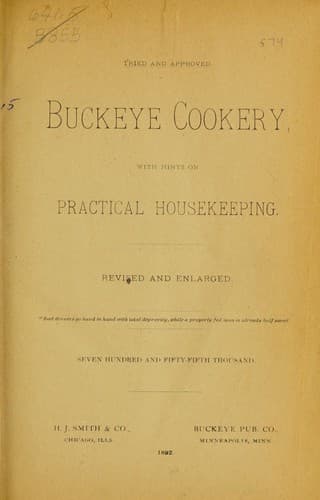
Buckeye cookery
1892376 readable pages · 755 recipe records · general household and domestic management cookbook
From the librarian's dossier · AI-generated, grounded in the scanned text
Buckeye Cookery (1892) is a sprawling American household manual that goes far beyond recipes to cover the full domestic world of a late-19th-century home. Compiled from contributions credited to individuals across Ohio and other states, it opens with detailed bread-making instruction before moving through cakes, fried foods, custards, confectionery, canning, sauces, beverages, eggs, fish, game, jellies and jams, meats, pastry, puddings, pickles, poultry, salads, shellfish, soups, and vegetables. Beyond the kitchen, it addresses housekeeping philosophy, furniture and cleaning, servant management, laundry, soap-making, cellar and food storage, infant care, sickroom nursing and invalid cookery, personal hygiene and beauty preparations, emergency first aid, gardening, food chemistry, and household hints like dyeing fabric and building cisterns. The book closes with a substantial alphabetical index. With 755 anchored food records alongside smaller clusters of household and medicinal entries, this volume functioned as a comprehensive guide to running an entire household, not merely a cooking reference. Modern readers will find it a rich window into domestic life, values, and technique of its era, written with the practical, moralizing voice typical of period housekeeping manuals, treating good cooking and orderly homekeeping as connected to family health and social stability.
The book is organized into 34 recovered sections that move from food preparation fundamentals to broader domestic management. It begins with bread-making (sections 1-2), then cakes and frying (sections 4-6), confectionery and preserving (sections 7, 11, 14), sauces and beverages (section 8), eggs and fish (section 9), game and frozen desserts (section 10), meats (sections 11-12, 27-28), pastry and puddings (sections 12-14), pickles (section 15), poultry and salads (section 17), soups and shellfish (section 18), vegetables (sections 19-20), entertaining and economical cooking (section 21), then a long run of household-management material: housekeeping philosophy and cleaning (sections 22, 24-26), marketing and provisioning (section 27), butchering and carving (section 28), laundry and cleaning (sections 29-30), food storage and infant care (section 31), sickroom nursing and invalid cookery (sections 32-33), personal hygiene and first aid (sections 33-34), gardening and food chemistry (section 36), miscellaneous household hints and dyeing (section 37), and finally an alphabetical index (section 38). Recipes throughout carry contributor names and locations, reflecting the book's compiled, community-sourced origin.
Recipes from this book
747 records extracted from the text, showing the first 50 in reading order. Each links to a modern interpretation.
Read the book
376 readable pages. A dot marks pages with recipe records.