
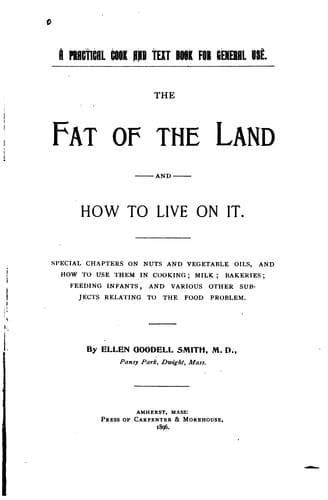
A practical cook and text book for general use
1896Ellen Goodell Smith · 106 readable pages · 129 recipe records · vegetarian household cookbook and health reform treatise
From the librarian's dossier · AI-generated, grounded in the scanned text
Published in 1896, this is Ellen Goodell Smith's practical vegetarian cookbook and health manifesto rolled into one volume. Smith, presenting herself as an experienced health reformer and teacher of hygienic living, argues throughout that a diet of vegetables, fruits, nuts, and whole grains is the natural human diet, and that meat, dairy, and overly refined foods are responsible for widespread sickness, crime, and social decay. Alongside this sustained argument, the book delivers genuinely practical content: advice on kitchen utensils, instructions for making whole grain breads, gems, and crackers, recipes for vegetables, beans, nuts, and salads, and guidance on substituting plant-based oils and butters for animal products. The book blends recipe instruction with polemic, drawing on historical, ethical, and economic arguments against meat-eating and dairy consumption, including critiques of animal slaughter, infant feeding practices, and the financial costs of an animal-based diet. Readers today will find both a period piece of dietary reform advocacy and a working cookbook, complete with an index and period advertisements for health foods and kitchen equipment. It offers a window into late Victorian vegetarian and hygienic reform movements as much as it does a set of usable recipes.
The book opens with front matter and philosophical chapters justifying vegetarianism (section 1), then moves through argumentative chapters on humane treatment of animals and practical chapters on kitchen utensils (section 2). It proceeds into discussions of milk and fat substitutes and a history of bread-making (section 3), followed by detailed bread and grain recipes (section 4). A gap in the summaries appears between sections 4 and 6. The book continues with vegetable, legume, and nut cultivation content (section 6), nut recipes and salads (section 7), critiques of pastries and dairy along with infant feeding discussion (section 8), and further ethical and economic arguments against meat consumption alongside the book's stated purpose (section 10). It closes with an index and advertisements for health foods and kitchen equipment (section 11). Overall the structure alternates between reform argument chapters and practical recipe or technique chapters.
Recipes from this book
129 records extracted from the text, showing the first 50 in reading order. Each links to a modern interpretation.
Read the book
106 readable pages. A dot marks pages with recipe records.