
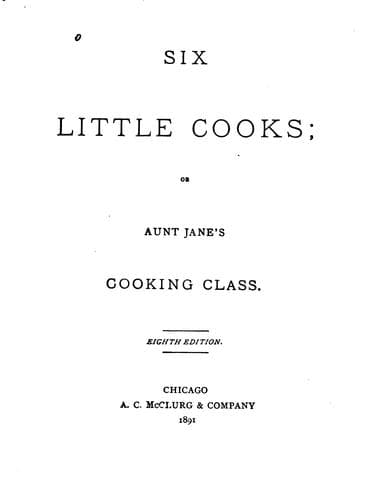
Six little cooks
1910Elizabeth Stansbury Kirkland · 81 readable pages · 209 recipe records · juvenile narrative cookbook
From the librarian's dossier · AI-generated, grounded in the scanned text
Six Little Cooks, published in 1910 by Elizabeth Stansbury Kirkland, is a juvenile cookbook that tells the story of a group of young girls learning to cook under the guidance of their Aunt Jane over the course of a summer. Rather than presenting recipes as a plain reference list, the book weaves cooking instruction into a narrative of numbered lesson days, following the girls from simple candy-making and breakfast preparation through more advanced skills like pastry, invalid cookery, picnic planning, and party hosting. The recipes themselves, numbered and anchored throughout the text (209 food records in total), range from candies and cakes to soups, croquettes, and dumplings. The book culminates in the girls hosting an elegant supper, demonstrating the domestic competence they have gained. Written for a young audience, likely girls, and framed as both entertainment and instruction, the book reflects a period when cooking manuals for children combined moral lessons about serving others with practical kitchen technique. Modern readers will find a charming blend of storytelling and recipe collection that offers a window into turn-of-the-century domestic training and household expectations for girls.
The book is organized as a sequence of numbered lesson days (from the fifth through the last day, based on section headings), each built around a cooking occasion such as a lunch, breakfast, picnic, or party. Individual recipes are numbered sequentially throughout (for example No. 15 through No. 167 and beyond) and are embedded within the narrative rather than grouped by ingredient or dish type. Section 9 is an advertising page for other works by the same author and publisher, appended after the main narrative concludes in section 8.
Recipes from this book
209 records extracted from the text, showing the first 50 in reading order. Each links to a modern interpretation.
Read the book
81 readable pages. A dot marks pages with recipe records.