
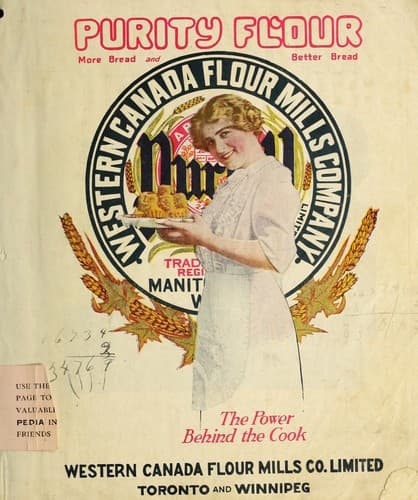
Purity flour cookbook
1917E. Warner · 86 readable pages · 461 recipe records · general household cookbook
From the librarian's dossier · AI-generated, grounded in the scanned text
The Purity Flour Cookbook (1917) is a promotional household cookbook produced by E. Warner to showcase the versatility of Purity Flour and related Purity brand products. Structured as a comprehensive kitchen manual, it moves through the full range of domestic cookery expected of an early twentieth century household, from breads, pastries, and cakes to soups, meats, poultry, vegetables, preserves, and confectionery. With 461 anchored food records across its sections, it functions as a practical daily reference rather than a narrow specialty text. The book reflects the economical and nutritionally conscious cooking style of its era, including sections on invalid cookery and cereal-based dishes meant to stretch household budgets. Readers will find detailed technique notes on pastry making, meat roasting times, candy temperatures, and preserving methods, all grounded in the kitchen realities of 1917. As a branded flour company cookbook, it doubles as both an instructional guide and a piece of commercial literature, with Purity Flour and Purity Oatmeal referenced throughout as preferred ingredients. Modern readers approaching this text will encounter it as a window into period foodways, domestic economy, and the marketing of packaged flour products in early twentieth century Canada and the United States.
The book is organized as a sequential household cookbook moving from baked goods to full meal cookery and finally to preserving and confectionery. It opens with muffins, quick breads, pastry, and cakes (section 2), followed by frostings, cookies, and cereal dishes (section 3), then puddings, frozen desserts, sauces, and invalid cookery (section 4). The middle sections address cheese, soups, fish, shellfish, and poultry (section 5), poultry and meat cookery (section 6), and further meat, egg, and vegetable preparations (section 7). The later sections cover salads, sandwiches, candy, and fruit preserving (section 8), concluding with pickles, catsups, jellies, and marmalades (section 9). Headings within sections are often specific dish names rather than broad categories, suggesting a dense, recipe-by-recipe presentation typical of period flour company cookbooks.
Recipes from this book
461 records extracted from the text, showing the first 50 in reading order. Each links to a modern interpretation.
Read the book
86 readable pages. A dot marks pages with recipe records.