
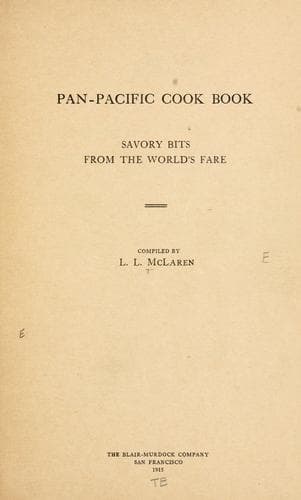
Pan-Pacific cook book
1915L. L. McLaren · 88 readable pages · 490 recipe records · international household cookbook
From the librarian's dossier · AI-generated, grounded in the scanned text
The Pan-Pacific Cook Book, compiled by L. L. McLaren and published in 1915, is a sprawling international recipe collection assembled around the moment of San Francisco's Panama-Pacific International Exposition. Drawing on dishes attributed to more than sixty countries and regions, it presents nearly 500 anchored food entries organized by course and category rather than by nationality, though each recipe is typically labeled with its country or culture of origin. The preface frames the book as a practical resource for American housewives seeking economical, achievable dishes from around the globe, reflecting the cosmopolitan curiosity that the Exposition itself celebrated. Readers move through hors d'oeuvres and soups, fish and shellfish, sauces, eggs and vegetables, entrees and lunch dishes, meats and poultry and game, salads and cold dishes, cheese, pancakes and fritters, desserts and cakes, and finally breads, candies, and punches. The scope ranges from Mexican, Chilean, and Argentine dishes to French, German, Russian, Chinese, Japanese, and Hawaiian preparations, all rendered in instructions aimed at home cooks with basic culinary skill. For modern readers, it offers a window into how early twentieth-century American domestic cookery imagined and adapted a world of cuisines for the middle-class kitchen.
The book is organized by food category and course rather than strictly by country, moving from hors d'oeuvres, cocktails, and savories through soups, fish and shellfish, sauces and dressings, egg entrees, vegetable entrees, entrees and lunch dishes, meat poultry and game, salads and cold dishes, cheese, pancakes fritters dumplings and pastes, sweet sauces, desserts, cakes, breads, candies, and punches across 9 sections. Within each category, recipes are numbered sequentially and individually labeled by country or region of origin, so a single section such as vegetable entrees might move from German to French to Armenian preparations in short succession. This produces a structure that is thematic by course but deliberately international in juxtaposition, consistent with the stated aim of classifying recipes by countries within a household cookbook framework.
Recipes from this book
490 records extracted from the text, showing the first 50 in reading order. Each links to a modern interpretation.
Read the book
88 readable pages. A dot marks pages with recipe records.