
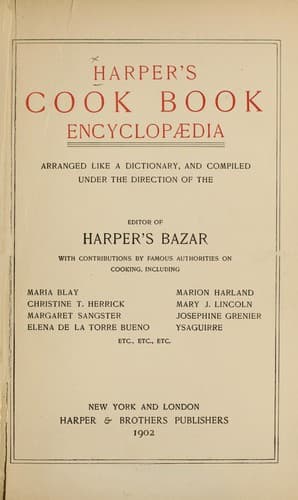
Harper's cook book encyclopædia
1902499 readable pages · 1,785 recipe records · alphabetical culinary encyclopedia
From the librarian's dossier · AI-generated, grounded in the scanned text
Harper's Cook Book Encyclopaedia (1902) is a massive alphabetically arranged American cookbook, organized like a dictionary of food rather than a book of menus or chapters. Spanning roughly 1,785 anchored food entries across 49 sections, it moves from Agrodolce and almonds at the start through beef, breads, cakes, candies, fish, shellfish, game, poultry, meats, sauces, soups, vegetables, and finally rice and potato dishes at the close. The book is a working reference for a well-staffed turn-of-the-century American kitchen, blending homely staples like Boston brown bread and corn pudding with French-influenced formal dishes such as galantines, vol-au-vents, and chaudfroids. It opens with practical front matter: time-tables for roasting and boiling, weights and measures, notes on chafing-dish cookery, invalid cookery, and kitchen economy. Modern readers will find it a fascinating window into the elaborate, French-inflected style of upper-middle-class American entertaining at the turn of the twentieth century, as well as a rich record of period vocabulary, technique, and ingredient assumptions. It is best approached as a reference work to browse and sample rather than read straight through, given its dictionary structure and sheer scope of recipes and cross-references.
The book is organized alphabetically by ingredient or dish name, dictionary-style, beginning with an introductory reference section (section 1) covering time-tables, weights and measures, and kitchen equipment before the entries proper begin. Major ingredient categories occupy long alphabetical runs: beef (sections 2-3), beverages and breads (sections 3-5), cakes and candies (sections 6-9), cheese and creams (sections 9-12), eggs and omelets (sections 12-13), fish and shellfish (sections 13-17), force-meats and fruit desserts (sections 18-21), game and gravies (sections 21-23), ice creams and jellies (sections 23-25), mutton, lamb, and pickles (sections 26-28), pies and pork (sections 29-31), poultry (sections 31-33), preserves and puddings (sections 33-37), salads, sandwiches, and sauces (sections 37-40), soups (sections 41-43), sweetbreads and veal (sections 44-46), and vegetables including potatoes and rice (sections 46-49). Cross-references appear throughout, directing readers to related recipes elsewhere in the volume.
Recipes from this book
1,785 records extracted from the text, showing the first 50 in reading order. Each links to a modern interpretation.
Read the book
499 readable pages. A dot marks pages with recipe records.