
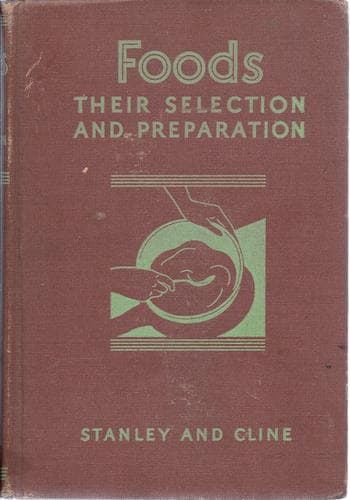
Foods, their selection and preparation
1935Louise Stanley · 349 readable pages · 158 recipe records · college home economics textbook and general household cookbook
From the librarian's dossier · AI-generated, grounded in the scanned text
First published in 1935 by Louise Stanley and later revised with Jessie Alice Cline, this college-level textbook approaches cookery as applied nutrition science rather than as a simple recipe collection. It opens by explaining why diets fail (poverty, habit, ignorance) and grounds every subsequent chapter in the vocabulary of carbohydrates, proteins, fats, minerals, and vitamins introduced at the start. From there it moves methodically through the American food supply of its era: sugar and candy, fruits and vegetables, cereals and rice, eggs, milk and cheese, fats and oils, frozen desserts, salads, meats, poultry, fish, legumes and nuts, batters and doughs, flours, cakes, breads, pies, and beverages such as coffee, tea, and cocoa, closing with condiments and meal planning. Throughout, the authors pair scientific explanation (grading standards, digestibility, chemical changes during cooking) with concrete kitchen instruction, tables of proportions, and buying guidance tied to federal grading systems of the period. It reads as both a home economics course text and a practical kitchen reference, useful today as a window into how nutrition science, food industry standards, and household cookery were taught together to mid-twentieth-century American students and homemakers.
The book proceeds from foundational nutrition science (sections 1 and 2) through a long sequence of chapters organized by food category or cooking technique: sugar cookery and candy, fruits, vegetables, cereals and rice, eggs, cakes and custards, milk, cheese, fats and oils, frozen desserts, salads, meat (selection, grading, cooking), poultry, fish and shellfish, legumes and nuts, batters and doughs, flours, cakes and icings, cookies, yeast breads and rolls, pies and pastries, meringues, coffee and tea, cocoa and chocolate, condiments, and finally meal planning and service with an appendix of nutritive value tables. Numbered chapter headings (using roman numerals in places, such as XIV, XIX, XX, XXVI) indicate a structured textbook progression rather than an alphabetical arrangement. Several sections (3, 10, 19, 20, 27) are not represented in the summaries provided, so gaps exist in this account of the book's full content.
Recipes from this book
158 records extracted from the text, showing the first 50 in reading order. Each links to a modern interpretation.
Read the book
349 readable pages. A dot marks pages with recipe records.