
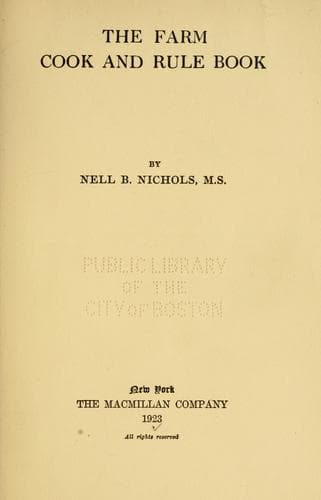
The farm cook & rule book
1923Nell Beaubien Nichols · 144 readable pages · 626 recipe records · general household and farm cookbook with domestic economy manual
From the librarian's dossier · AI-generated, grounded in the scanned text
The Farm Cook & Rule Book (1923) by Nell Beaubien Nichols is a comprehensive household manual written for rural American women who, unlike their urban counterparts, still needed to bake their own bread, cure their own meat, make their own soap, and preserve their own harvest. The book blends standardized, modernized recipes with practical farm-household management, reflecting the author's stated intent to bring precision (level measures, defined oven temperatures) to inherited family recipes so that farm cooks would waste less and succeed more often. Its scope runs from everyday cookery (breads, cakes, meats, vegetables, preserves, candies) to broader domestic self-sufficiency (canning, vinegar-making, meat curing, soap and starch making, home remedies, and cooking for the sick). With 626 anchored food records and only 3 household records identified separately, the book is overwhelmingly a cookbook, though its later sections shade into general home economics. Readers today will find a vivid record of what it meant to run a self-sufficient farm kitchen in the early 1920s, including guidance on canning safety, appliance use, and invalid cookery that has since become historical curiosity rather than active practice. It closes with an extensive alphabetical index covering the full range of recipes and household tips.
The book proceeds from foundational kitchen skills to specialized topics in roughly the order a farm cook would need them. It opens with measuring standards, oven temperatures, and beverages (section 1), then moves through yeast breads, quick breads, and cakes (sections 1-3), cookies, doughnuts, cereals, and candies (section 3), candied fruits and canning (section 4), catchups, pickled fruits, preserves, jellies, and early desserts (section 5), frozen desserts, gelatin dishes, eggs and cheese, and icings (sections 6-7), meats, poultry, fish, and wild game (section 7), pastry, salads, and sandwiches (sections 8-9), sauces, soups, and vegetables (sections 9-10), vinegar-making and large-quantity cooking (section 10), meat curing and household management (sections 11-14), and finally cooking for the sick with a closing index (sections 14-15). The later third of the book shifts from recipes toward household equipment, cleaning, beauty remedies, and invalid cookery, showing the book's dual identity as cookbook and domestic manual.
Recipes from this book
623 records extracted from the text, showing the first 50 in reading order. Each links to a modern interpretation.
Read the book
144 readable pages. A dot marks pages with recipe records.