
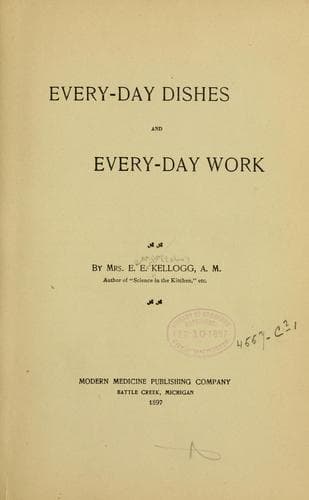
Every-day dishes and every-day work
1897E. E. Kellogg · 114 readable pages · 399 recipe records · vegetarian household cookbook with domestic economy guide
From the librarian's dossier · AI-generated, grounded in the scanned text
Every-day Dishes and Every-day Work is an 1897 American cookbook by E. E. Kellogg, built around a vegetarian and health-reform approach to home cooking. Rather than a simple recipe collection, it opens with a discussion of the purposes of food and the nutritive elements found in common foods, then moves through cereals, breads, fruits, vegetables, legumes, soups, eggs, desserts, pastries, and cakes. A distinctive feature is its coverage of proprietary Battle Creek Sanitarium Health Food Company products such as granose, nuttose, gluten preparations, and caramel-cereal, framed as digestible alternatives to conventional meat and coffee. The book closes with substantial household management material covering economy, leftovers, stove and fuel handling, cleaning, and sample menus, followed by a detailed index. With 399 anchored food records, the volume represents both a working kitchen manual and a vehicle for promoting a particular dietary philosophy tied to the Sanitarium's health teachings. Modern readers will find it a useful window into late 19th-century American vegetarian cookery, domestic science, and the commercial health food movement, though its instructions and medical framing reflect the assumptions of its era rather than present-day practice.
The book proceeds from introductory nutritional theory (section 1) through cereals and bread-making (sections 1 to 3), fruit preservation and canning (sections 4 to 5), legumes and vegetables (sections 5 to 6), soups and eggs (sections 6 to 7), desserts, puddings, sauces, and pastry (sections 8 to 9), a dedicated section on Battle Creek Sanitarium Health Food Company products such as granose, gluten, and nuttose (sections 9 to 10), and finally household economy, cleaning, fuel management, and sample menus (sections 10 to 11), closing with a comprehensive alphabetical index (section 12).
Recipes from this book
399 records extracted from the text, showing the first 50 in reading order. Each links to a modern interpretation.
Read the book
114 readable pages. A dot marks pages with recipe records.