
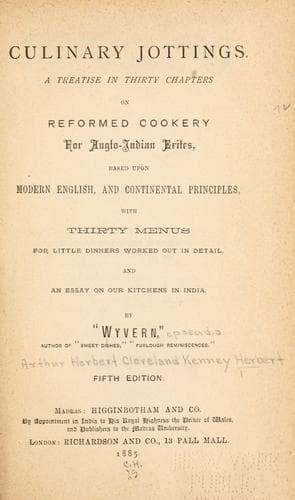
Culinary jottings
1885A. R. Kenney-Herbert · 293 readable pages · 428 recipe records · general household cookbook with menu-planning guide
From the librarian's dossier · AI-generated, grounded in the scanned text
Culinary Jottings is a practical, opinionated cookbook written under the pen name Wyvern by A. R. Kenney-Herbert, first published in 1885 for Anglo-Indian households, particularly military and colonial families based around Madras. The book sets out to reform what the author saw as the heavy, monotonous cookery common in British India, replacing it with lighter, French-influenced menus and techniques adapted to local ingredients, climate, and kitchen staff. It combines instructional chapters on soups, sauces, fish, entrees, vegetables, curries, pastry, and camp cookery with an extensive Part II of sample menus intended to guide the household cook through complete dinners. Throughout, the author addresses the realities of managing native cooks, working with inconsistent local produce and equipment, and adapting classical French technique to a hot climate with limited access to certain ingredients. The tone is didactic and confident, mixing recipe instruction with commentary on kitchen management, service style, and the social customs of colonial dining. Modern readers will find both a snapshot of Victorian Anglo-Indian domestic life and a working reference for period French-English cookery, though the recipes assume period stoves, measures, and a household staff structure quite different from a contemporary kitchen.
The book opens with prefatory material and an introduction on menu planning and the management of cooks (section 1), then proceeds through topical chapters: kitchen equipment and store-room organization, soups and purees (sections 2 to 3), fish and entrees (sections 4 to 5), sauces, roasting, and braising (sections 5 to 7), vegetables and rechauffes (sections 8 to 10), omelettes, luncheons, and fritters (sections 11 to 12), hors d'oeuvres and savoury toasts (section 13), rice, cheese, meat curing, and pastry (section 15), curries and mulligatunny (sections 17 to 18), and camp cookery (sections 18 to 19). The book then shifts into Part II, a long sequence of numbered menus for dinners of various sizes, each followed by detailed recipes for the dishes named in that menu (sections 19 to 27). It closes with miscellaneous advanced recipes, coffee-making instructions, and two concluding essays on kitchen design and the case for English-style cooking ranges in India (sections 28 to 29).
Recipes from this book
428 records extracted from the text, showing the first 50 in reading order. Each links to a modern interpretation.
Read the book
293 readable pages. A dot marks pages with recipe records.