
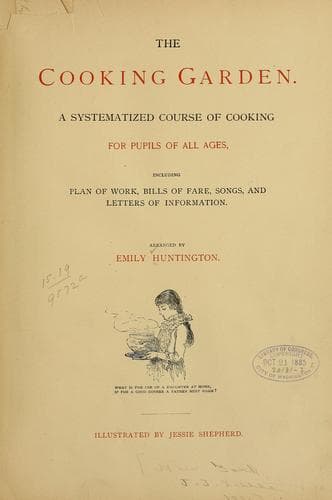
The cooking garden
1885Emily Huntington · 48 readable pages · 72 recipe records · pedagogical cooking course for students
From the librarian's dossier · AI-generated, grounded in the scanned text
The Cooking Garden (1885) by Emily Huntington is not a conventional household cookbook but a structured teaching curriculum designed to instruct pupils, described as suitable for all ages, in the fundamentals of practical cooking. Presented as a sequel to Huntington's earlier work, Kitchen Garden, the book organizes its content into a series of numbered lessons, each built around a bill of fare, required utensils and materials, cost considerations, an ordered sequence of exercises, and recipes, supplemented by explanatory letters and review questions meant to reinforce learning. The lessons progress from basic techniques such as toast and potato preparation through eggs, meats, bread, vegetables, fish, soups, and desserts, closing with a substantial collection of instructional songs tied to cooking tasks and household themes. Rather than simply listing recipes, the book reflects an educational philosophy built on hands-on practice in small groups, careful attention to economy and nutrition, and repeated recapitulation of technique. Readers today will find it a window into a specific pedagogical movement in domestic education, connected to institutions like the Wilson Industrial School for Girls, as much as a source of period recipes.
The book is arranged as a sequence of lessons rather than a topical recipe index. Section 1 opens with teacher-facing introductory material, a materials list for a class of twelve pupils, an introductory letter to pupils, and the first two lessons on toast and potatoes. Section 2 continues with recapitulation of potato techniques before moving into eggs and meats. Section 3 progresses through warmed-over meat dishes, bread-making, vegetable cookery, and the start of fish cookery. Section 4 completes the fish lesson and adds soups and desserts. Section 5 closes the book with a large set of cooking-themed songs, suggested bills of fare for various meals, concluding remarks on cooking education for women, and information about the Wilson Industrial School for Girls.
Recipes from this book
72 records extracted from the text, showing the first 50 in reading order. Each links to a modern interpretation.
Read the book
48 readable pages. A dot marks pages with recipe records.