
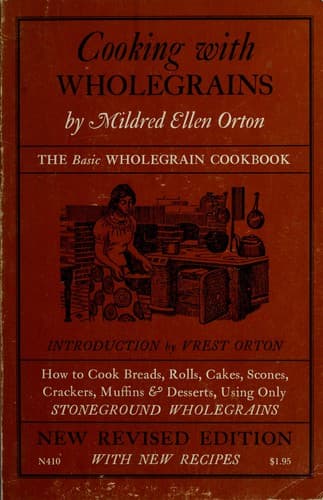
Cooking with wholegrains
1947Ellen Orton · 25 readable pages · 95 recipe records · regional and household wholegrain cookbook
From the librarian's dossier · AI-generated, grounded in the scanned text
Cooking with Wholegrains is a 1947 American cookbook by Ellen Orton, built around a single conviction: that industrial milling had stripped flour of its nutritional value and that home bakers should return to wholegrain flours and traditional stone-ground meals. The book opens not with recipes but with an argument, an introductory essay (attributed within the text to Vrest Orton) on the history of milling and the shift from stone mills to roller mills in the mid-1800s. From there it moves into a substantial recipe collection covering yeast breads, quick breads, muffins, griddlecakes, biscuits, luncheon and supper dishes, and a final stretch of steamed puddings, cakes, and cookies. Regional and traditional American dishes such as Boston Brown Bread, Indian Pudding, corn pone, and hush puppies sit alongside more standard bread and pastry recipes, all adapted to wholegrain flours like wheat, rye, corn, buckwheat, and oatmeal. With 95 anchored food records across just three gated sections, this is a dense, recipe-heavy volume aimed at readers converting their everyday baking away from refined white flour. It reads as part manifesto, part practical kitchen manual, offering both an argument for whole grains and the techniques needed to bake successfully with them.
The book is organized in three broad movements. Section 1 begins with a historical and nutritional argument about milling before introducing yeast breads and rolls. Section 2 shifts to quick breads, muffins, popovers, biscuits, griddlecakes, scones, dumplings, and savory luncheon and supper dishes, organized under headings like Muffin Meal Recipes and Quick Breads, Steamed Breads & Doughnuts. Section 3 closes the book with steamed puddings (especially Indian Pudding variations), pastry fundamentals, cakes, cookies, cereal preparation instructions, and a full recipe index.
Recipes from this book
95 records extracted from the text, showing the first 50 in reading order. Each links to a modern interpretation.
Read the book
25 readable pages. A dot marks pages with recipe records.