
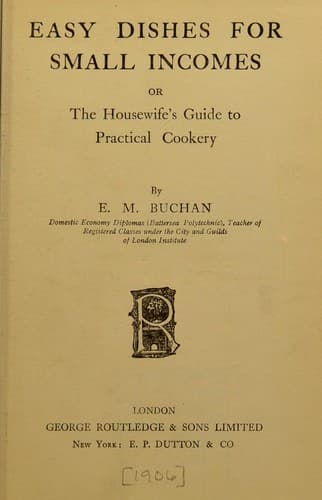
Easy dishes for small incomes, or, The housewife's guide to practical cookery
1906E. M. Buchan · 55 readable pages · 300 recipe records · general household cookbook
From the librarian's dossier · AI-generated, grounded in the scanned text
Easy Dishes for Small Incomes, or The Housewife's Guide to Practical Cookery is a 1906 household cookbook by E. M. Buchan, written for readers managing tight domestic budgets. It moves from foundational cooking methods and dietary principles through a full progression of everyday dishes, soups, fish, meats, vegetables, puddings, cakes, breakfast fare, sauces, preserves, pickles, beverages, and food prepared for the sick. Anchored records show roughly 300 identifiable food entries across the book, reflecting its dense, recipe-heavy structure. The preface notes the book arose from some form of collaboration, though the summaries do not elaborate further. Throughout, the text emphasizes economical ingredients such as suet, breadcrumbs, and seasonal fruit, alongside plain techniques suited to a modestly equipped kitchen. Practical household matters, including marketing, food storage, and cleaning kitchen ranges and gas stoves, sit alongside the recipes themselves, underscoring the book's aim of guiding a household through the full round of domestic cookery rather than offering only recipes in isolation. For the modern reader, it offers a window into turn of the century British and American influenced home cooking, with its blend of nutritional reasoning, invalid cookery, and traditional preparations giving a fuller picture of how a careful housewife of limited means was expected to run a kitchen.
The book opens with introductory material: a preface, contents listing sample menus, a list of kitchen utensils, cooking method principles (roasting, grilling, baking, boiling, frying, steaming, stewing), a dietetics discussion, invalid cookery basics, and marketing and stove care guidance. From there it proceeds through soups and fish, then into an extended run of meat, poultry, and vegetable recipes across sections 2 and 3. Desserts, puddings, pastries, cakes, biscuits, and preserved fruits occupy sections 3 and 4. Section 5 shifts to baked goods, breakfast and light dishes, salads, sauces, and preserves. Section 6 closes the book with chutneys and pickles, beverages both plain and medicinal, further invalid cookery, basic pantry staples like homemade baking powder, and a final index of recipes organized by category.
Recipes from this book
300 records extracted from the text, showing the first 50 in reading order. Each links to a modern interpretation.
Read the book
55 readable pages. A dot marks pages with recipe records.