
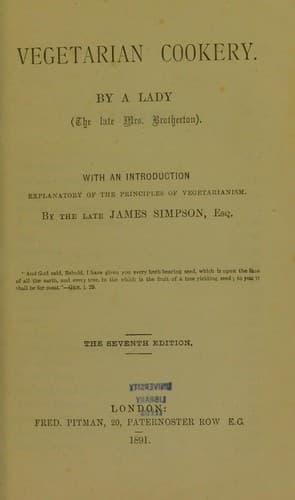
Vegetarian cookery
1891Martha Brotherton · 159 readable pages · 624 recipe records · vegetarian household cookbook with introductory dietary polemic
From the librarian's dossier · AI-generated, grounded in the scanned text
Vegetarian Cookery is an 1891 domestic manual by Martha Brotherton, opening with a lengthy argumentative introduction by James Simpson that defends vegetarianism on anatomical, chemical, economic, and medical grounds before moving into thirteen sections of recipes. The book covers the full range of Victorian household cookery reimagined without meat, from soups, omelets, vegetables, and sauces through puddings, pastries, creams and jellies, breads, biscuits and cakes, preserves, beverages, pickles, and finally a dedicated section of invalid cookery. It reflects a Victorian conviction that a meatless diet could be scientifically justified, economically sound, and every bit as varied and refined as conventional fare. Readers today will find both a period nutritional argument and a working household reference, complete with detailed instructions on ingredient ratios, boiling times, and presentation suited to a servant-supported Victorian kitchen. The presence of three graduated dietary styles (strict, with dairy and eggs, and more elaborate) shows the author accommodating different degrees of commitment among her readers. The book is part polemic and part practical cookbook, offering a window into how vegetarianism was defended and practiced in late nineteenth-century Britain.
The book opens with an introductory and argumentative section (sections 1 and 2) laying out the case for vegetarianism through anatomical, chemical, economic, and public-health evidence, including parliamentary testimony on diseased meat. Section 4 then establishes three graduated dietary styles and begins the recipe portion with breakfast, dinner, and supper menus and soup recipes. The recipe chapters proceed in a traditional cookbook sequence: soups, omelets and fritters (sections 4-5), eggs and vegetables (sections 6-7), sauces and cheese dishes (section 7), an extensive multi-section run of puddings, sandwiches and salads (sections 8-9), pastries and prepared fruit (section 10), creams, jellies, and molded desserts (section 11), dairy products, breads, and tea-cakes (section 12), biscuits, buns, and cakes (sections 13-14), preserved fruits, jams, jellies, and marmalades (section 14), syrups, beverages, pickles, condiments, and porridges (section 15), and finally a discrete section of invalid cookery and therapeutic preparations (section 16). Numbered recipe headings appear throughout later sections, suggesting a sequential numbering system across the whole recipe collection.
Recipes from this book
624 records extracted from the text, showing the first 50 in reading order. Each links to a modern interpretation.
Read the book
159 readable pages. A dot marks pages with recipe records.