
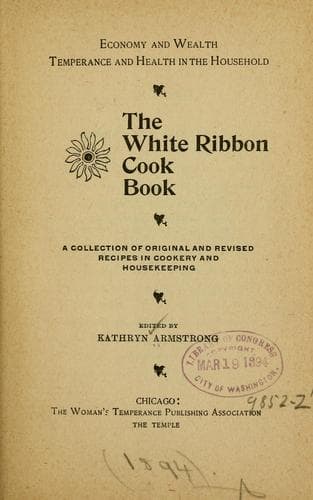
The white ribbon cook book
1894Kathryn Armstrong · 135 readable pages · 688 recipe records · general household cookbook
From the librarian's dossier · AI-generated, grounded in the scanned text
The White Ribbon Cook Book (1894) is a household culinary manual attributed to Kathryn Armstrong, organized in the tradition of Victorian domestic cookbooks that combine practical recipes with household science. Its title signals ties to temperance advocacy, and the book's content bears this out through its inclusion of non-alcoholic beverages, medicinal cordials, and sick-room cookery aimed at nourishing the ill without recourse to alcohol. The book moves through the standard architecture of a full household manual: soups, fish, poultry and game, meats, sauces and stocks, vegetables, salads and pickles, eggs, breads and cakes, pastries and puddings, desserts and candies, frozen treats, preserves and canning, dairy and cheese, beverages, and finally sick-room and children's cookery capped with nutritional reference tables. With roughly 688 anchored food records across its fourteen sections, the book offers modern readers a dense, practical window into the domestic kitchen and nutritional thinking of the late nineteenth century, useful both as a historical culinary reference and as an artifact of the temperance movement's reach into everyday household management.
The book proceeds section by section through a comprehensive domestic cookery sequence: introductory cooking techniques and a cooking time-table (section 1), soups (section 1), fish and shellfish (section 2), poultry and game (sections 2-3), meats including beef, pork, veal, mutton, lamb, and curries (sections 3-4), sauces and stocks (section 5), vegetables (sections 5-6), salads and pickles (section 6), preserving and egg cookery (section 7), forcemeats, breads and cakes (sections 7-9), pastry and puddings (sections 9-10), pies (section 10), desserts, candies, and frozen treats (sections 11-12), preserves and canned fruits (sections 12-13), jellies, dairy dishes, cheese-making, and beverages (section 13), and concludes with sick-room cookery, children's foods, and extensive nutritional reference tables (sections 13-14). The organization follows a logical kitchen workflow from savory to sweet to medicinal, ending with reference material rather than recipes proper.
Recipes from this book
688 records extracted from the text, showing the first 50 in reading order. Each links to a modern interpretation.
Read the book
135 readable pages. A dot marks pages with recipe records.