
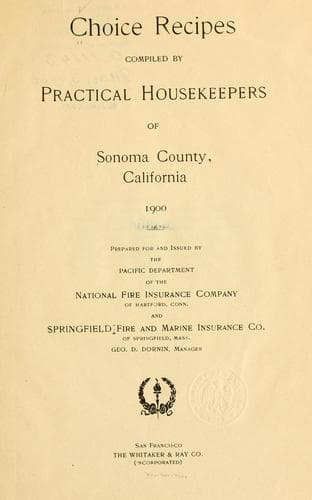
Choice recipes
190029 readable pages · 200 recipe records · general household cookbook
From the librarian's dossier · AI-generated, grounded in the scanned text
Choice Recipes (1900) is a community-compiled American cookbook assembled by housekeepers of Sonoma County, California. Like many church and club cookbooks of its era, it gathers practical, tested recipes from named local contributors into a single household reference. The book moves through the full arc of a period kitchen's responsibilities: breads and yeast preparation, soups, fish, entrees, meats, vegetables, and salads, followed by an extensive run of puddings, pies, frozen desserts, and cakes, and closing with pickles, preserves, breakfast and luncheon dishes, invalid cookery, and dried fruit preservation. With 200 anchored food records, it offers a dense, practical snapshot of upper-middle-class domestic cooking at the turn of the twentieth century. The attribution of many recipes to specific women (Mrs. Delano, Miss Laughlin, Mrs. Purrington, and others) gives the book a communal, almost scrapbook-like character, typical of fundraising or club-produced cookbooks of the period. Modern readers will find it valuable both as a working recipe collection and as a document of household economy, hospitality, and domestic labor in 1900 America. The inclusion of invalid cookery and a table of weights and measures underscores its role as an all-purpose household manual rather than a purely culinary showcase.
The book is organized into three broad sections that follow a traditional meal-and-pantry progression. Section 1 opens with bread and yeast recipes before moving through soups, fish, entrees, meats, and vegetables, ending with an extensive salad and dressing section. Section 2 shifts to sweets, covering puddings, pies, frozen desserts, and a wide range of cakes with fillings and frostings. Section 3 closes the book with pickles and preserves, breakfast and luncheon dishes, a dedicated section for invalid cookery, a method for cooking dried fruits, and finally a table of weights and measures followed by period advertisements. This progression, from staples to mains to desserts to preserved goods and reference material, reflects a standard organizational logic for household cookbooks of the era.
Recipes from this book
200 records extracted from the text, showing the first 50 in reading order. Each links to a modern interpretation.
Read the book
29 readable pages. A dot marks pages with recipe records.