
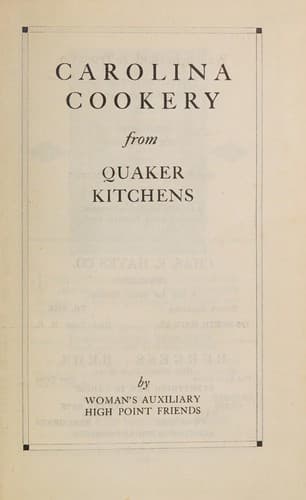
Carolina cookery from Quaker kitchens
1924High Point Friends Meeting. Woman's Auxiliary · 42 readable pages · 258 recipe records · community fundraiser cookbook
From the librarian's dossier · AI-generated, grounded in the scanned text
Carolina Cookery from Quaker Kitchens is a 1924 community cookbook compiled by the Woman's Auxiliary of High Point Friends Meeting in North Carolina. Like many church and civic fundraiser cookbooks of its era, it gathers recipes contributed by named individuals into a practical household reference, ranging from breads and corn meal dishes to meats, vegetables, salads, cheese, pies, sandwiches, beverages, candies, and pickles. The collection reflects a regional Southern table filtered through Quaker community life, with dishes such as Southern Sally Lunn, Brunswick Stew, and Sweet Potato Biscuit sitting alongside more genteel additions like cheese souffle and frozen fruit salad. The book opens with a foreword and grace, signaling its communal and devotional origins, and closes with practical kitchen guidance, a table of equivalent measures, and local advertisements that anchor it firmly in its time and place. For the modern reader, it offers a window into domestic cooking, household economy, and small-town commercial life in 1920s High Point, North Carolina. It is a working kitchen manual rather than a literary text, valuable today both for its recipes and as a document of community and regional foodways.
The book is organized into thematic sections beginning with breads, corn meal dishes, eggs, soups, and meats (section 1), followed by further meat preparations, vegetables, salads, cottage cheese and cheese dishes, and supper items (section 2). Later material (section 4) covers pies, sandwiches, beverages, candies, and pickles and preserves, ending with household hints. A final section (section 5) provides cooking technique tips, a table of equivalent measures, and an index to advertisers, with the book closing on local business advertisements rather than recipe content.
Recipes from this book
258 records extracted from the text, showing the first 50 in reading order. Each links to a modern interpretation.
Read the book
42 readable pages. A dot marks pages with recipe records.