
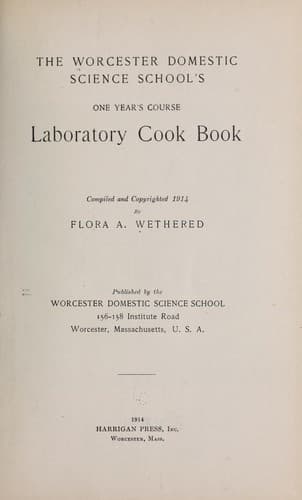
The Worcester domestic science school's one year course laboratory cook book
1914Worcester domestic science school, Worcester, Mass. · 134 readable pages · 554 recipe records · institutional cooking school laboratory manual
From the librarian's dossier · AI-generated, grounded in the scanned text
This is a 1914 laboratory cook book produced by the Worcester Domestic Science School in Massachusetts, designed to accompany a one-year course of instruction in cookery. Rather than a general household recipe collection aimed at casual home cooks, it functions as a structured teaching manual, moving from the chemistry of fuels and stoves through food preservation, fundamental food science, and progressively more advanced culinary techniques. Readers encounter over 500 anchored food entries ranging from canned fruits and jellies to elaborate frozen desserts, candies, and formal multi-course dinner menus. The book blends scientific explanation (combustion, egg coagulation, starch cookery) with hands-on recipes and closes with etiquette instruction, household cleaning advice, and a bibliography of domestic science references. It offers a window into how early twentieth-century American cooking schools trained students, treating cookery as both a practical skill and an applied science, with attention to economy, sanitation, and the social rituals of formal dining. Modern readers will find it useful less as a source of quick weeknight recipes and more as a documentary artifact of institutional home economics education, showing how fuel selection, food preservation, nutrition classification, and etiquette were taught together as a unified discipline preparing students for both domestic and professional food service roles.
The book proceeds as a sequence of lectures and laboratory sections, beginning with fuels, stoves, and food preservation (sections 1 to 2), then moving into fish, shellfish, and vegetables (sections 4 to 5), soups, sandwiches, pastry, and meats (sections 5 to 7), salads, eggs, cheese, and croquettes (section 8), puddings, frozen desserts, and candy (sections 10 to 11), cakes and the fireless cooker (section 12), and finally formal dining protocol, special-occasion menus, household cleaning, and a bibliography (sections 13 to 14). The organization mirrors a course syllabus, with topics building in complexity from basic technique to advanced confectionery and social presentation.
Recipes from this book
554 records extracted from the text, showing the first 50 in reading order. Each links to a modern interpretation.
Read the book
134 readable pages. A dot marks pages with recipe records.