
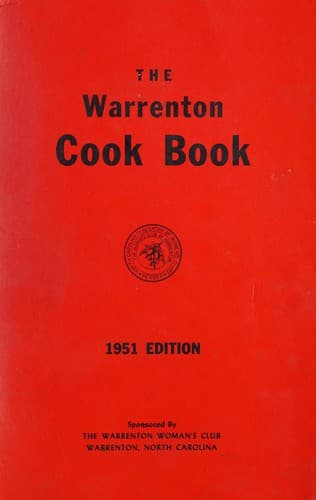
The Warrenton cook book
1951Warrenton Woman's Club (N.C.) · 25 readable pages · 138 recipe records · community household cookbook
From the librarian's dossier · AI-generated, grounded in the scanned text
The Warrenton Cook Book (1951) is a community cookbook compiled by the Warrenton Woman's Club of North Carolina, gathering 138 identified food recipes across a broad domestic range: beverages, breads, candies, cakes, desserts, meats, seafood, pies, preserves, salads, and vegetables. Like many club-produced cookbooks of its era, it opens not with recipes but with verses and light household advice, including pieces titled A Recipe for Happiness and To Preserve a Husband, signaling that the book is meant as much as a token of community identity and domestic sentiment as a practical kitchen tool. The recipes themselves reflect mid-twentieth-century Southern American home cooking, with heavy representation of quick breads, molded gelatin salads, home canning and preserving, and an assortment of cakes and candies suited to church suppers, family gatherings, and everyday meals. Readers today will find it a window into the foodways, domestic values, and community life of a small North Carolina town at mid-century. The tone throughout is warm, practical, and occasionally whimsical, blending technical instruction with folksy charm. It is a useful primary source for understanding how local women's organizations recorded and shared culinary knowledge in the postwar United States.
The book is organized into three mechanically gated sections that move through a fairly conventional cookbook progression. Section 1 opens with introductory verses and household advice before moving into technical charts for blanching vegetables and preparing fruit, then covers beverages, breads, candies, cookies, and cakes with icings. Section 2 continues with desserts and sauces, then meat, egg, fish and cheese dishes, an extensive pie section, and a large collection of pickles, jellies, relishes, and catsups for home preserving. Section 3 concludes with salads and dressings, vegetables, and a closing miscellany called Short Cuts to Happy Eating, which offers quick tips and improvised recipes. The overall arrangement follows a household categories model typical of club-produced cookbooks rather than a strict alphabetical or menu-based structure.
Recipes from this book
138 records extracted from the text, showing the first 50 in reading order. Each links to a modern interpretation.
Read the book
25 readable pages. A dot marks pages with recipe records.