
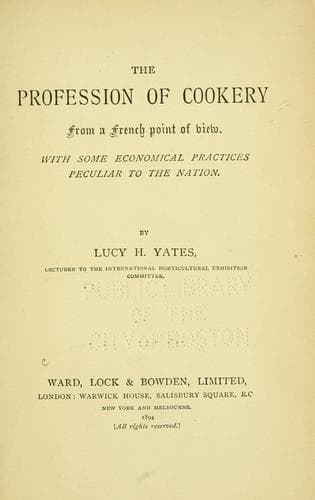
The profession of cookery, from a French point of view
1894Lucy H. Yates · 89 readable pages · 196 recipe records · French-influenced household cookery manual
From the librarian's dossier · AI-generated, grounded in the scanned text
The Profession of Cookery, from a French Point of View (1894) is Lucy H. Yates's argument for adopting French domestic cooking methods in British kitchens, framed as both a practical manual and a polemic against English wastefulness. Yates presents cooking as a serious discipline deserving intellectual attention, contrasting French thrift, resourcefulness, and equipment with what she portrays as English ignorance and extravagance in the kitchen. The book moves through soups and purees, vegetables and salads, pastry and desserts, meatless Lenten and Friday dishes, cheese preparations, ways to use leftovers through fricassees and rechauffe cooking, and finally menus and recipes for entertaining, from midday meals to small dinners and supper dishes. Throughout, the emphasis falls on economy, seasoning, presentation, and techniques drawn from French household and professional practice. The text is aimed at readers managing modest households who want to stretch ingredients further while still producing refined, appetizing meals. Modern readers will find a window into Victorian attitudes about national cooking styles, domestic economy, and the moral weight placed on thrifty housekeeping, alongside a substantial body of period French-inflected recipes rendered for an English-speaking audience. The volume closes with publisher's advertisements for other reference and instructional works of the era.
The book is organized as a sequence of numbered chapters moving from culinary philosophy to practical recipes. It opens with an introductory argument for economy in cookery (section 1), then proceeds through soups and purees, vegetables and vegetable dishes, salads, pastry and desserts including gateaux and compotes, meatless maigre dishes for Lenten and Friday observance, cheese dishes and rechauffe techniques for using leftovers, lesser-used vegetables, and finally chapters on entertaining, covering the dejeuner a la fourchette, menus for small dinners, and choice supper dishes. The later sections (8 and 9) shift into a dense recipe collection followed by an index and substantial publisher's advertisements for other reference and instructional books, which are not part of the cookery content proper.
Recipes from this book
196 records extracted from the text, showing the first 50 in reading order. Each links to a modern interpretation.
Read the book
89 readable pages. A dot marks pages with recipe records.