
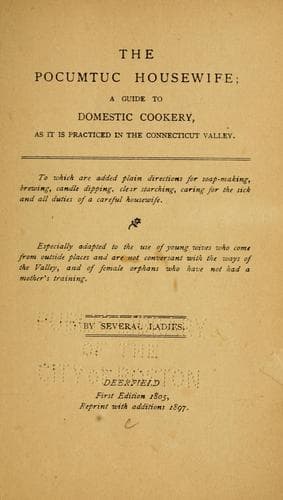
The Pocumtuc housewife
189724 readable pages · 109 recipe records · general household cookbook and domestic manual
From the librarian's dossier · AI-generated, grounded in the scanned text
The Pocumtuc Housewife is an 1897 domestic manual rooted in the farm households of the Connecticut Valley, likely intended as a practical primer for young or inexperienced housewives, including the orphans it explicitly mentions. Rather than a narrow recipe collection, it functions as a full guide to running a rural New England home, covering daily meals, baking, preserving, home remedies, and household manufacturing like soap and candles. Readers will find instructions for heating brick ovens, making breads leavened with beer emptins, preparing boiled dinners and roasted meats, and building out an extensive repertoire of puddings, cakes, and cookies. The book also blends culinary content with medicinal remedies for coughs, colds, and consumption, alongside instructions for starching linens, dyeing fabric, and making candles and shoe blacking from household materials. This mixture reflects a period when a housewife's duties extended well beyond cooking into food preservation, basic medicine, and small-scale manufacturing. The book closes with local Greenfield, Massachusetts advertisements and a publisher's colophon, anchoring it firmly in its regional commercial context. For modern readers, it offers a window into the self-sufficient, economy-minded household culture of late 19th-century rural New England, presented with a practical, instructional tone throughout.
The book is organized into three broad sections. Section 1 opens with everyday eating patterns for farm households, organized by meal (breakfast, dinner, supper), then moves into oven heating and baking day instructions, breads, griddle cakes, and meat dishes. Section 2 shifts to sweets and comfort foods, puddings, cakes, cookies, gingerbread, doughnuts, and custards, before pivoting into a substantial medical remedies section, food for invalids, soap-making, starching, and homemade beverages. Section 3 is the shortest and most miscellaneous, covering preservation and household manufacturing tasks such as candle dipping, potato starch, tea and coffee substitutes, shoe blacking, rose water, and fabric dyes, ending in advertisements and the publisher's colophon.
Recipes from this book
109 records extracted from the text, showing the first 50 in reading order. Each links to a modern interpretation.
Read the book
24 readable pages. A dot marks pages with recipe records.