
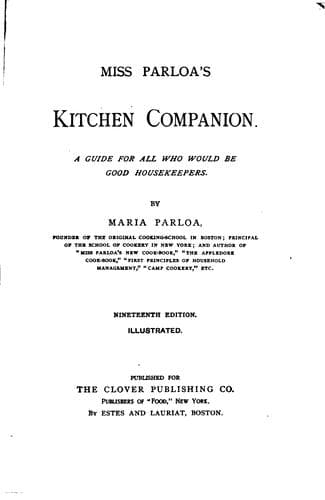
Miss Parloa's kitchen companion
1887Maria Parloa · 503 readable pages · 1,227 recipe records · general household cookbook and domestic management manual
From the librarian's dossier · AI-generated, grounded in the scanned text
Miss Parloa's Kitchen Companion (1887) is Maria Parloa's comprehensive guide to running a well-ordered late nineteenth-century American household kitchen. Far more than a recipe collection, it opens with detailed advice on designing and equipping kitchens, pantries, and storerooms, then moves through an enormous range of culinary instruction covering soups, fish, shellfish, meats, poultry, game, vegetables, eggs, sauces, breads, cakes, puddings, frozen desserts, preserves, and invalid cookery. With over a thousand anchored food records, the book reflects the ambitions of a professional cooking teacher writing for households that aspired to both economy and refined, French-influenced entertaining. Parloa pays close attention to technique and reasoning, explaining the chemistry of leavening, the science of searing meat, and the principles behind clear stocks and smooth sauces, rather than simply listing ingredients. The book closes with menus for formal entertaining, an extensive index, and publisher advertisements that place the work within the commercial world of contemporary cookbook publishing. For modern readers, it offers a detailed window into elite and middle-class domestic life, kitchen technology, and dining customs of the 1880s, written by one of the era's most prominent culinary educators.
The book proceeds from household infrastructure to finished dishes to social occasions. It begins with sections on kitchen, pantry, and storeroom design and furnishing (sections 1 to 3), followed by foundational ingredients, flavorings, and marketing advice (section 5). Soups occupy an extensive stretch (sections 6 to 9), followed by fish and shellfish (sections 9 to 12), then a long sequence on meats, poultry, and game moving from basic cooking methods to elaborate French-style entrees (sections 13 to 21). Eggs, cheese, omelets, and salads follow (sections 22 to 23), then garnishes, force-meats, and sauces (sections 24 to 26), and an extensive vegetable section (sections 26 to 29). Miscellaneous meat cookery, breakfast dishes, and pastry basics appear in sections 30 to 31, followed by a very large dessert sequence covering pies, puddings, frozen desserts, jellies, charlottes, and cakes (sections 32 to 42). Breads and beverages follow (sections 42 to 44), then preserving and canning (section 45), a chapter on food for the sick (sections 46 to 47), and finally entertaining guidance with menus and bills of fare (section 49), an alphabetical index (section 50), and publisher advertisements (section 51).
Recipes from this book
1,227 records extracted from the text, showing the first 50 in reading order. Each links to a modern interpretation.
Read the book
503 readable pages. A dot marks pages with recipe records.