
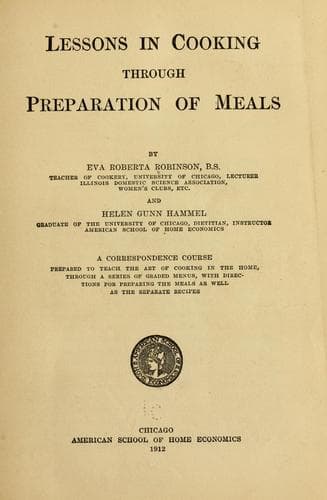
Lessons in cooking through preparation of meals
1912Eva Roberta Robinson · 248 readable pages · 752 recipe records · structured home economics cooking course
From the librarian's dossier · AI-generated, grounded in the scanned text
Published in 1912, Lessons in Cooking Through Preparation of Meals by Eva Roberta Robinson is a structured home economics correspondence course rather than a simple recipe collection. Organized as a year-long sequence of numbered lessons, it teaches cooking by walking the student through the actual daily work of planning and preparing breakfast, lunch, and dinner, meal by meal, week by week, season by season. The book opens with foundational material on weights, measures, heat application, and food composition before moving into daily lessons that combine recipes with timing instructions so that multiple dishes finish together. Beyond recipes, it addresses household economy: food costs, nutritional values, fuel choices for stoves, kitchen organization, canning and preserving, diet for the sick, formal dinner service, and even detection of food adulteration. Menus are tied to specific months, reflecting a seasonal approach to marketing and cooking. The book closes with supplementary recipes, a bibliography, a multilingual culinary glossary, and an extensive index. Written for the aspiring or working home cook, it blends practical technique with the era's emerging scientific approach to nutrition and household management. Modern readers will find it as much a manual of domestic method and economy as a source of period recipes, offering a detailed window into how an early twentieth-century American household kitchen was expected to run.
The book is organized as a sequential curriculum of numbered lessons (reaching well over 260) grouped into weekly and monthly units, beginning with introductory tables and definitions in section 1 and ending with supplementary recipes, a bibliography, glossary, and index in sections 23 through 25. Each lesson typically presents recipes for a meal alongside a 'Preparing the Meal' timing guide that coordinates multiple dishes to finish simultaneously. Interspersed among the daily lessons are thematic interludes: nutritional and cost tables (sections 3, 4, 10, 12, 13, 15, 19, 23), kitchen equipment and fuel guidance (sections 6, 8, 12, 14), canning and preserving instruction (sections 17, 19), diet for the sick (section 17), food adulteration detection (section 21), and formal dinner and entertaining etiquette (sections 13, 15, 22, 23). The book closes with two index sections (24 and 25) and a description of a related 'Library of Home Economics' course.
Recipes from this book
752 records extracted from the text, showing the first 50 in reading order. Each links to a modern interpretation.
Read the book
248 readable pages. A dot marks pages with recipe records.