
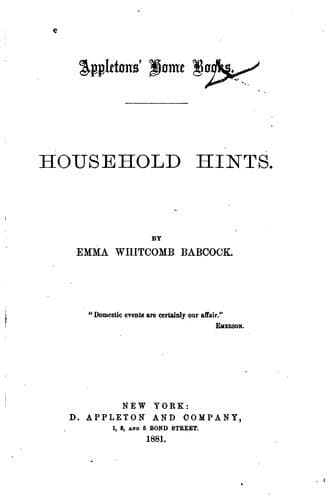
Household hints
1881Emma Whitcomb Babcock · 79 readable pages · 145 recipe records · general household cookbook and domestic advice manual
From the librarian's dossier · AI-generated, grounded in the scanned text
Household Hints (1881) by Emma Whitcomb Babcock is a dual-purpose Victorian domestic manual that blends a substantial recipe collection with essays on household philosophy and family management. Published by D. Appleton & Co., the book opens by reassuring the young housekeeper that good management is a learnable skill rather than an inherited gift, then moves through bread and yeast making, meats, soups, fish, vegetables, puddings, pickles, cakes, candies, and fruit preserving. Later sections shift toward essays on raising children, managing servants, maintaining marital harmony, entertaining modestly, and keeping a cheerful, orderly home. Throughout, Babcock intersperses practical cleaning and mending tips, home decoration ideas, and even brief medical remedies alongside her culinary instructions. The book closes with reflections on marriage and child discipline, followed by publisher advertisements for related Appleton titles. Modern readers will find it a window into the domestic expectations, kitchen technology, and social attitudes of an educated American housewife writing for peers in the early 1880s. It is as much a guide to character and household order as it is a cookbook, reflecting the era's blending of practical instruction with moral and social advice for women running a home.
The book moves from an introductory address to the young housekeeper (section 1) through a long sequence of recipe categories: bread, tea, and coffee; meats, soups, and fish (sections 1-2); gravies, fish, shellfish, salads, puddings and pies (section 2); pickles, cakes, and candies (section 3); and fruit preservation methods like canning and jelly-making (section 4). Around the midpoint, the book transitions into household management essays and miscellaneous domestic advice, mixing sewing, cleaning, decoration, and family relationship topics with occasional recipes (section 5). The final third (sections 6 through 8) is devoted almost entirely to essays on housekeeping philosophy, child-rearing, servants, marriage, and social life, with the book closing on essays about discipline and marriage followed by publisher advertisements for other Appleton household titles (section 8).
Recipes from this book
145 records extracted from the text, showing the first 50 in reading order. Each links to a modern interpretation.
Read the book
79 readable pages. A dot marks pages with recipe records.