
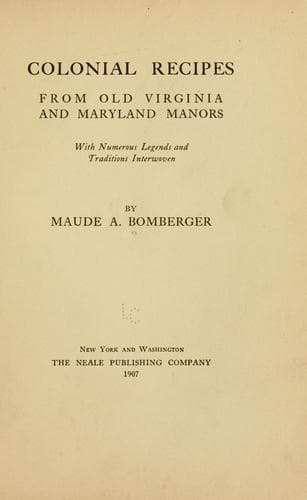
Colonial recipes, from old Virginia and Maryland manors
1907Maude A. Bomberger · 27 readable pages · 80 recipe records · colonial revival household cookbook with genealogical narrative
From the librarian's dossier · AI-generated, grounded in the scanned text
Published in 1907, Colonial Recipes from Old Virginia and Maryland Manors by Maude A. Bomberger is less a practical kitchen manual than a genealogical scrapbook of foodways attributed to famous colonial estates. Organized around historic manor houses, primarily Mount Vernon and other Virginia and Maryland properties, the book pairs recipes with anecdotes about the families who supposedly originated them, including the Washingtons, Lees, Custises, and Ridgelys. Readers will find beverages, cakes, pickles, puddings, sauces, and soups presented not as isolated instructions but as heirlooms, each tied to a story of courtship, wartime service, or family lineage. The book reflects an early twentieth century fascination with colonial revival culture, using food as a vehicle for celebrating Revolutionary War heritage and old Southern gentry. Alongside recipes for terrapin, canvasback duck, mint juleps, and quince brandy, the text includes toasts and poetic tributes that reveal as much about social customs and nostalgia as about cooking technique. This is a book to be read as much for its historical narrative and family lore as for its culinary content, offering a window into how a certain class of American readers in 1907 imagined and romanticized their colonial past through food.
The book is organized into two main parts corresponding to geography: Part I covers Virginia manors beginning with Mount Vernon, and Part II covers Maryland manors including Hampton, Glen Ellen, Waverly, Belmont, Winston, Kingston Hall, and Castle Howe. Front matter includes an index to recipes organized by category (beverages, bread and pastry, cakes, meats, pickles, puddings, sauces, soups) and a separate index to manors. Within each part, recipes are grouped by estate, with historical and genealogical narrative interwoven between recipes rather than separated into a distinct reference section. Section 2 includes a notable thematic digression on mint, gathering multiple mint-based recipes together. Section 3 shifts toward specific Maryland families such as those of Weldon and Boonesborough, and closes with a collection of toasts rather than recipes.
Recipes from this book
80 records extracted from the text, showing the first 50 in reading order. Each links to a modern interpretation.
Read the book
27 readable pages. A dot marks pages with recipe records.