
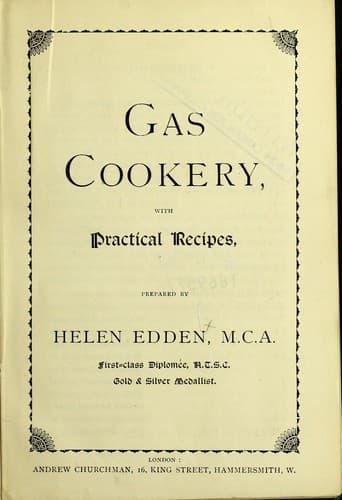
Gas cookery
1885Helen Edden · 63 readable pages · 338 recipe records · general household cookbook
From the librarian's dossier · AI-generated, grounded in the scanned text
Gas Cookery is a late Victorian household cookbook by Helen Edden, M.C.A., devoted to demonstrating the advantages of gas ranges over traditional coal ovens. Published in 1885, it presents itself explicitly as a practical guide, opening with instruction on oven management, roasting, boiling, baking, and grilling using gas heat before moving into an extensive recipe collection. The book spans soups, fish and seafood, poultry and game, meat dishes, puddings and desserts, breads and cakes, sauces, vegetables, and even invalid cookery for the sick or convalescent. Throughout, recipes are anchored to the technology of the gas burner, with repeated attention to flame adjustment and temperature control, a novelty the author clearly wishes to promote to a domestic readership accustomed to coal-fired kitchens. The scope ranges from everyday preparations like stock and boiled chicken to elaborate French-influenced dishes such as Quails a la Strasbourg and Turkey Galantine, reflecting the refined, service-oriented cookery of well-staffed Victorian households. A glossary and comprehensive index close the volume, alongside period advertisements for commercial food products, situating the book firmly within its commercial and domestic context. Modern readers will find it a window into both a specific culinary technology transition and the broader conventions of professional English cookery instruction of the 1880s.
The book proceeds from general instruction to specific recipe categories. Section 1 opens with an introduction to gas cookery's benefits and technique, then launches into soups and fish dishes. Section 2 continues with meat, poultry, and further fish preparations, emphasizing sauteing, braising, and baking. Section 3 covers elaborate game and meat presentations alongside a long run of puddings, custards, jellies, and ices. Section 5 (the summaries jump from 3 to 5, suggesting a section 4 not included here) covers pastry, breads, and cakes, transitioning into sauces. Section 6 is dominated by an extensive sauce compendium, plus vegetable cookery, invalid cookery, and preserving. Section 7 closes the book with miscellaneous recipes, garnishing notes, a glossary of culinary terms, a full index, and period advertisements.
Recipes from this book
338 records extracted from the text, showing the first 50 in reading order. Each links to a modern interpretation.
Read the book
63 readable pages. A dot marks pages with recipe records.