
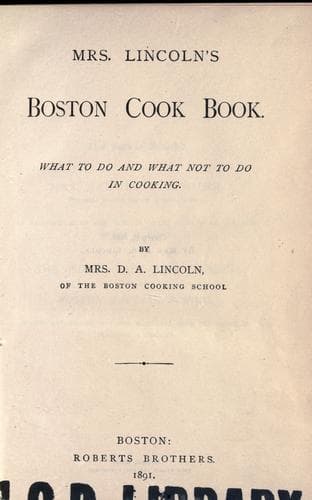
Mrs. Lincoln's Boston cook book
1884Lincoln, Mary Johnson Bailey "Mrs. D. A. Lincoln," · 315 readable pages · 678 recipe records · general household cookbook and domestic science textbook
From the librarian's dossier · AI-generated, grounded in the scanned text
Mrs. Lincoln's Boston Cook Book (1884) is a comprehensive American household cookbook written by Mrs. D. A. Lincoln for pupils of the Boston Cooking School and for housekeepers of all skill levels. Rather than offering a bare list of recipes, it explains the chemistry and physiology behind cooking, covering fire and stove management, the physics of boiling and frying, and later the science of digestion and nutrition. The bulk of the book moves through bread and yeast, beverages, soups and stocks, fish and shellfish, eggs, meats, poultry and game, leftovers and rechauffe dishes, vegetables, salads, pastry, puddings, frozen desserts, cakes, preserving and pickling, and invalid cookery for the sick. It closes with kitchen equipment lists, a course of instruction at the Boston Cooking School, examination questions, a culinary glossary, an index, and period advertisements. With 678 anchored food records, this is a substantial reference work reflecting the domestic science movement and the commercial food culture of 1880s Boston. The author's didactic voice consistently explains the reasoning behind techniques, making the book as much an educational text as a recipe collection, intended to build understanding rather than rote following of instructions.
The book opens with front matter, a preface explaining its dual purpose for cooking school pupils and home cooks, and an introduction to the science of heat, fire, and stoves (section 1). It then proceeds methodically through cooking methods (section 2), measuring and bread chemistry (sections 3 to 5), breads, cakes, and griddle preparations (section 7), beverages and soup fundamentals (sections 8 to 10), fish and shellfish (sections 10 to 12), eggs and meat basics (section 13), beef, mutton, lamb, veal, pork, and poultry (sections 14 to 16), leftover and prepared meat dishes (section 17), vegetables (sections 18 to 19), pastry and puddings (sections 19 to 21), frozen desserts and cakes (sections 22 to 23), fruit preserving and canning (section 24), invalid cookery (section 25), kitchen management and nutritional science (sections 27 to 29), and finally pedagogical material, examination questions, a course of instruction, a glossary, indexes, and advertisements (sections 30 to 32). The organization reflects both a practical cookbook and a textbook for a cooking school curriculum.
Recipes from this book
678 records extracted from the text, showing the first 50 in reading order. Each links to a modern interpretation.
Read the book
315 readable pages. A dot marks pages with recipe records.