
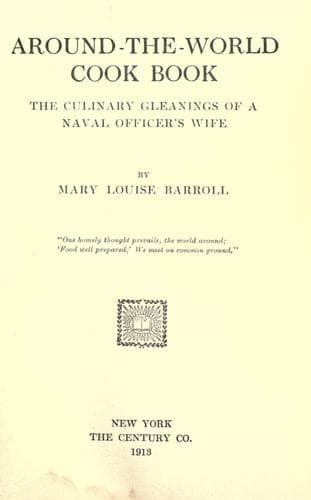
Around-the-world cook book
1913Mary Louise Barroll · 122 readable pages · 548 recipe records · general household cookbook
From the librarian's dossier · AI-generated, grounded in the scanned text
The Around-the-World Cook Book (1913) by Mary Louise Barroll is a large American household cookbook compiled by a naval officer's wife, drawing on recipes gathered through travel, friends, and regional American traditions. Organized in the manner of comprehensive early twentieth-century household manuals, it moves from breads and appetizers through soups, fish, entrees, vegetables, eggs, sauces, salads, preserves, chafing-dish cookery, desserts, cakes, candies, and beverages before closing with household cleaning advice, personal care recipes, and home remedies. The book's title reflects its international ambitions, evident in recipes labeled Turkish, Mexican, Spanish, Creole, French, and other regional or national styles, sitting alongside distinctly American dishes like Brunswick stew and Lady Baltimore cake. With 548 anchored food records plus smaller numbers of household and medicinal entries, this is overwhelmingly a cookbook, though it includes the kind of household and self-care material commonly bundled into domestic manuals of its era. It offers a window into upper-class American entertaining and domestic life just before World War I, complete with formal French culinary terminology, elaborate molded and garnished dishes, and alcohol-forward punches and cordials for entertaining. Modern readers will find it a rich but dense period document rather than a streamlined recipe collection.
The book is arranged as Part I Receipts, opening with French culinary terminology and a cooking times table before proceeding through a long sequence of thematic sections: breads, hors d'oeuvres, soups, fish, meats and entrees, poultry and meat substitutes, rice and macaroni, vegetables, eggs, sauces, salads, pickles and preserves, chafing-dish recipes, sandwiches, desserts, cakes and cookies and candies, beverages, household cleaning and stain removal, personal care and perfumery, and finally home remedies, closing with an alphabetical index. The 12 sections in this dossier track that progression fairly closely, with recipe categories often spanning or blending across adjacent sections (for example salads appear in both sections 6 and 7, and candies span sections 9 and 10).
Recipes from this book
543 records extracted from the text, showing the first 50 in reading order. Each links to a modern interpretation.
Read the book
122 readable pages. A dot marks pages with recipe records.