
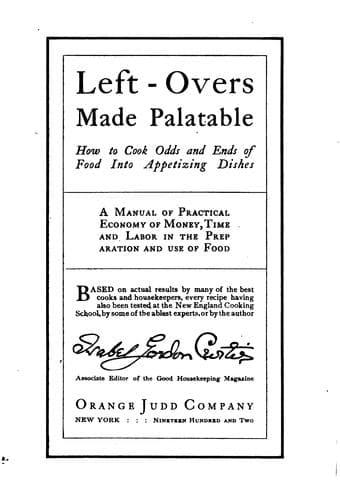
Left-overs made palatable
1902Isabel Gordon Curtis · 57 readable pages · 300 recipe records · leftover-cookery household cookbook
From the librarian's dossier · AI-generated, grounded in the scanned text
Left-Overs Made Palatable is a 1902 American cookbook by Isabel Gordon Curtis devoted entirely to the resourceful reuse of kitchen remnants. Rather than a general household manual, it is a focused, practical guide showing cooks how to transform stale bread, cold cereals, sour milk, leftover potatoes and vegetables, and remnants of beef, lamb, pork, poultry, and fish into freshly appealing dishes. The book also addresses stale cake, hardened cheese, and leftover fruit, closing with an alphabetical index and a brief turn toward entertaining and holiday cooking. Drawing on recipes tested at the New England Cooking School and contributed by experienced American cooks, Curtis blends thrift with refinement, insisting that economy need not mean monotony or poor presentation. With roughly 300 anchored recipes across six sections, the book offers a detailed window into turn-of-the-century American kitchen management, revealing period assumptions about food storage, reheating, and the social value of a well-run, waste-conscious household. Modern readers will find both a practical resource for reducing food waste and a historical record of domestic cooking techniques, sauces, and preservation methods from the early 1900s.
The book is organized by leftover ingredient category rather than by course or meal. It opens with fats, stale bread, and puddings (section 1), moves through cereals, coffee, and sour milk baking (section 2), then covers potatoes, vegetables, and foundational sauces (section 3). Sections 4 and 5 address meats in sequence, beef and veal, then lamb, pork and ham, poultry, and fish, each with dozens of recipes organized around the specific leftover ingredient. Section 6 closes with stale cake, cheese scraps, leftover fruit, an alphabetical index, and a short additional section on entertaining and Thanksgiving dishes. Headings throughout name specific dishes and techniques rather than broad chapter titles, suggesting a working reference organized for quick lookup by ingredient.
Recipes from this book
300 records extracted from the text, showing the first 50 in reading order. Each links to a modern interpretation.
Read the book
57 readable pages. A dot marks pages with recipe records.