
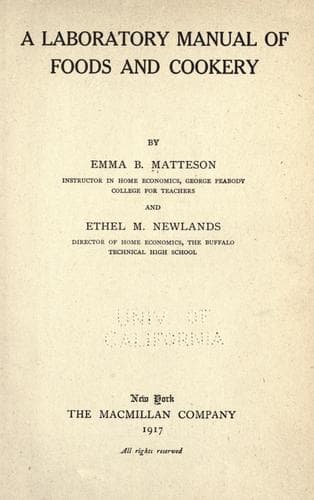
A laboratory manual of foods and cookery
1916Emma B. Matteson · 123 readable pages · 393 recipe records · laboratory manual and household science cookbook
From the librarian's dossier · AI-generated, grounded in the scanned text
This 1916 volume by Emma B. Matteson is a laboratory manual designed to teach cooking through the lens of experimental science. Rather than presenting itself as a simple recipe collection, it pairs chemistry, bacteriology, and biology experiments with tested culinary applications, moving from beverages and fruits through cereals, vegetables, dairy, eggs, meats, shellfish, baked goods, cakes and pastries, frozen desserts, and finally candy making. Readers encounter dozens of structured experiments alongside practical recipes, all framed within a home economics curriculum aimed at students learning both the science and craft of food preparation. The book reflects an early twentieth century movement to bring rigorous scientific method into domestic and institutional kitchens, with attention to nutrition tables, food preservation, and sanitary handling of ingredients. It is as much a textbook as a cookbook, blending instructional experiments on topics like microbial spoilage, gluten development, and sugar syrup stages with hundreds of anchored recipes ranging from simple stewed fruits to layered cakes and hand-dipped candies. For the modern reader, it offers a window into how cooking was professionalized and taught as applied science in the early 1900s, useful both as a historical culinary reference and as evidence of the home economics movement's pedagogical style.
The manual is organized into numbered chapters that proceed from beverages and fruits (sections 1 to 3) through cereals and vegetables (sections 3 to 4), milk products, cheese, and eggs (sections 4 to 5), meats and soups (section 6), shellfish and flour mixtures (section 8), breads and rolls (section 9), cakes, pastries, and pies (section 10), salads, dressings, and frozen desserts (sections 10 to 11), and finally candy making and a closing beverages chapter with an index (section 12). Each chapter typically opens with scientific explanation and numbered laboratory experiments before transitioning into standard recipes, often accompanied by nutritional value tables and, in some chapters, formal scoring rubrics such as Miss Bevier's score cards for bread and biscuits. The final section (13) consists of publisher advertisements for related household science textbooks rather than culinary content.
Recipes from this book
393 records extracted from the text, showing the first 50 in reading order. Each links to a modern interpretation.
Read the book
123 readable pages. A dot marks pages with recipe records.