
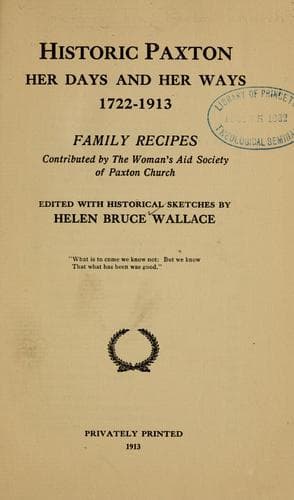
Historic Paxton, her days and her ways, 1722-1913
1913Helen Bruce Wallace · 83 readable pages · 157 recipe records · community memorial history and fundraising cookbook
From the librarian's dossier · AI-generated, grounded in the scanned text
Historic Paxton, Her Days and Her Ways is a 1913 commemorative volume produced by Helen Bruce Wallace to mark nearly two centuries of Paxton Presbyterian Church in Pennsylvania. The book pairs a substantial local history, tracing the church from its early log structure through frontier conflicts, Revolutionary and Civil War service, and decades of pastors and congregational life, with a large collection of recipes gathered from the church's Women's Aid Society members. The history section covers the contested origins of the town's name, the controversial career of the 'fighting parson' John Elder, the old graveyard, the manse, the schoolhouse, and eighty years of church memories recorded by a longtime member. The recipe section that follows offers breads, meats, vegetables, salads, pies, cakes, candies, and preserves, alongside household remedies, cleaning formulas, poultry care, and gardening advice. Together these halves reflect a common genre of the era: a fundraising or memorial book that blends local history and biography with practical domestic knowledge contributed by a community of women. Modern readers will find both a window into a Pennsylvania frontier congregation's self-told story and a snapshot of American home cooking and household management at the start of the twentieth century.
The book opens with a foreword and historical chapters (sections 1 through 5, based on numbering, though section 5 is not present in the provided summaries) covering the church's founding, naming disputes, Parson Elder's ministry, military history, and personal reminiscences of eighty years of congregational life, including monographs on individual ministers. Section 6 marks the transition point, finishing the church and graveyard history before introducing the recipe collection with breads, meats, oysters, vegetables, and salads. Sections 7 and 8 continue the recipe collection through salads, pies, desserts, cakes, small cakes, candies, and miscellaneous savory dishes, then shift into household remedies, cleaning and furniture care, poultry management, and gardening. Section 9 closes the book with an extended standalone essay on flower gardening. Recipes and instructional pieces are grouped by category with contributor names given in parentheses, following the pattern of contributed community cookbooks.
Recipes from this book
157 records extracted from the text, showing the first 50 in reading order. Each links to a modern interpretation.
Read the book
83 readable pages. A dot marks pages with recipe records.