
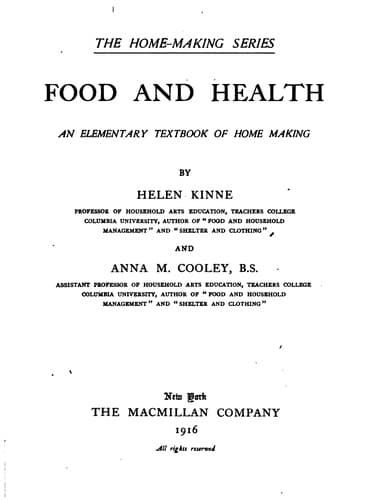
Food and health
1916Helen Kinne · 107 readable pages · 91 recipe records · home economics textbook and household cookbook
From the librarian's dossier · AI-generated, grounded in the scanned text
Food and Health is a 1916 American textbook by Helen Kinne, written for elementary and home-based instruction in nutrition, cookery, and household management. It uses a running narrative about Marjorie Allen and the students of Pleasant Valley School to frame practical lessons on preparing school lunches, planning family meals, and understanding the science behind food. The book blends recipes with explanations of nutrition, food safety, sanitation, and domestic economy, reflecting an educational approach that treats cooking as both a scientific subject and a civic skill. Readers encounter lessons on canning and preserving, potato and grain cookery, egg and cereal preparation, coffee brewing, quick breads, meat selection and cooking, vegetable gardening, desserts, and calorie counting. The text also covers kitchen design, dishwashing, food buying and selling, and even opportunities for girls to earn money through domestic enterprises. Interspersed with recipes are experiments demonstrating chemical and physical processes, such as starch behavior, baking powder reactions, and the effects of heat on proteins and fats. Structured as a graded course with numbered lessons and chapters, the book is both instructional manual and cookbook, aimed at teaching sound domestic practice through direct experience. Modern readers will find it a window into early twentieth-century home economics education, mixing recipes with lessons on hygiene, thrift, and scientific literacy.
The book is organized into numbered chapters and lessons rather than a simple recipe index, progressing from introductory material on nutrition and school lunches (section 1) through canning and preserving (section 4), potato and griddlecake cookery (section 5), breakfast foods (section 6), quick breads and kitchen design (section 7), meat and vegetables (section 8), desserts and cooking apparatus (section 9), calorie science and economics (section 10), and closing with experiments, basket lunch suggestions, and an extensive index (section 11). Recipes are embedded within instructional lessons rather than grouped by course, and each section typically combines practical recipes with explanatory text on nutrition, science, or household economy. A comprehensive index appears at the end, in section 11, linking topics across the entire book.
Recipes from this book
91 records extracted from the text, showing the first 50 in reading order. Each links to a modern interpretation.
Read the book
107 readable pages. A dot marks pages with recipe records.