
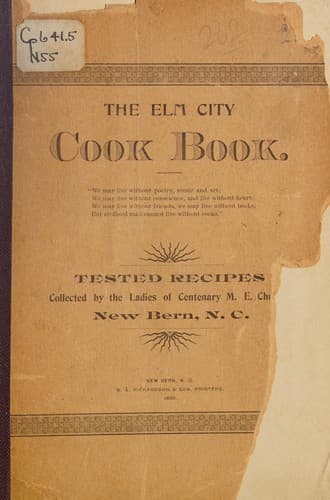
The Elm City cook book
1896N.C.) Centenary Methodist Episcopal Church (New Bern · 34 readable pages · 202 recipe records · general household cookbook
From the librarian's dossier · AI-generated, grounded in the scanned text
The Elm City Cook Book is an 1896 community cookbook compiled under the name of Centenary Methodist Episcopal Church in New Bern, North Carolina. Like many church and charitable cookbooks of its era, it gathers recipes contributed for practical household use, likely as a fundraising effort, and covers the full range of a late nineteenth-century American kitchen: cakes and frozen desserts, soups, salads, meats, fish, pickles, preserves, and egg dishes. The book reflects the domestic cooking culture of a small Southern city at the close of the century, blending everyday fare like baked apples and omelets with more elaborate entertaining dishes such as Nesselrode pudding and Martha Washington crab soup. Its pages also carry period advertisements for commercial products including gelatine, tapioca, and chocolate, as well as notices from local New Bern businesses, giving the book a dual identity as both a recipe collection and a community artifact. With 202 anchored food records across just three mechanically gated sections, it is a dense, practical reference rather than a literary or narrative cookbook. Modern readers will find it a useful window into regional American foodways, home preservation techniques, and the commercial food culture of the 1890s.
The book is organized into three gated sections that move through dessert-heavy material into a broader range of savory courses and preservation recipes. Section 2 focuses heavily on cakes, small cakes, and frozen or gelatine desserts, interspersed with period advertisements. Section 3 continues desserts and pies before broadening into salads, soups, meats, and fish, suggesting the original book grouped sweets and savory dishes into overlapping runs rather than strict alphabetical or course based chapters. Section 4 shifts into pickles, preserves, egg dishes, and vegetable and dairy recipes, concluding with an index and local advertisements. The presence of an index in section 4 indicates the book followed a topical arrangement common to community cookbooks of the period, with headings for individual dishes rather than long chapter introductions.
Recipes from this book
202 records extracted from the text, showing the first 50 in reading order. Each links to a modern interpretation.
Read the book
34 readable pages. A dot marks pages with recipe records.