
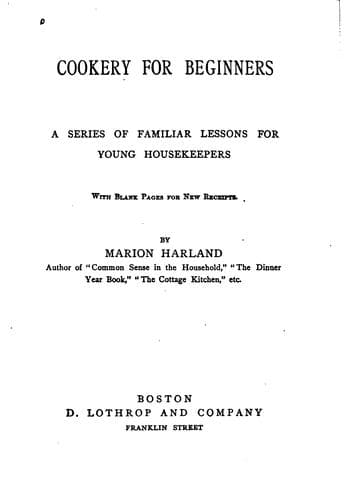
Cookery for beginners
1884Marion Harland · 33 readable pages · 102 recipe records · general household cookbook for beginners
From the librarian's dossier · AI-generated, grounded in the scanned text
Cookery for Beginners is an 1884 instructional cookbook by Marion Harland, aimed squarely at the novice housekeeper rather than the experienced cook. Structured as a graduated course, it begins with the most fundamental of domestic skills, making yeast and baking bread, before moving through breakfast dishes, roasting and boiling of meats, vegetable preparation, and finally the more decorative arts of jellies, creams, and beverages. The tone throughout is patient and pedagogical, treating cooking as a set of learnable techniques that reward attention to detail, timing, and temperature rather than intuition or improvisation. Harland positions bread-making as the cornerstone of household competence, and she builds outward from there toward increasingly refined dishes, culminating in fancy desserts and proper coffee and tea service. Modern readers will find a window into the domestic training expected of young women in well-off nineteenth-century American households, with an implicit curriculum running from plain, sturdy staples to elegant company fare. Though slim, with only a handful of sections, the book is dense with specific, hands-on instruction. It offers both a practical historical recipe collection and a portrait of how cooking was taught as a discipline of housewifery in its era, complete with an index organizing dishes by category for easy reference.
The book proceeds in a deliberate progression of difficulty. Section 1 opens with home-made yeast and bread fundamentals before moving into breakfast breads and egg dishes. Section 3 shifts to savory cookery, covering meat roasting and boiling technique alongside vegetable preparation, then introduces desserts such as custards, blanc-mange, and cakes. Section 4 closes the book with fancy cookery, jellies, creams, and beverages, followed by a comprehensive recipe index organized by category (breads, cakes, eggs, meats, soups, vegetables). The organization suggests a teaching sequence, from essential daily staples toward more elaborate, decorative dishes suited to entertaining.
Recipes from this book
102 records extracted from the text, showing the first 50 in reading order. Each links to a modern interpretation.
Read the book
33 readable pages. A dot marks pages with recipe records.