
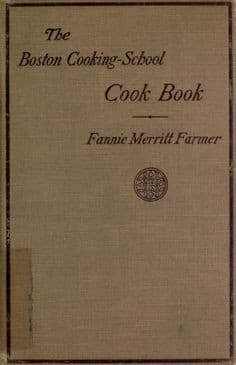
Boston Cooking-School cook book
1896Fannie Merritt Farmer, Lincoln, Mary Johnson Bailey "Mrs. D. A. Lincoln,", James B. Herndon , Herndon/Vehling Collection, Sam Sloan, D. A. Lincoln · 358 readable pages · 1,624 recipe records · general household cookbook
From the librarian's dossier · AI-generated, grounded in the scanned text
This dossier concerns the Boston Cooking-School Cook Book, associated with Fannie Merritt Farmer and Mary Johnson Bailey Lincoln ("Mrs. D. A. Lincoln"), a landmark American household cookbook first tied to 1896 but represented here in an expanded later edition judging by its scope. The book is a vast, systematically organized culinary reference covering nearly the entire range of American domestic cookery of its era: breads, soups, sauces, fish, shellfish, meats, poultry, vegetables, salads, desserts, cakes, candies, and preserving. It opens with technical fundamentals, temperature charts, measuring instructions, and menu-planning philosophy before moving methodically through courses in something resembling a formal dinner's structure. With over 1,600 anchored food records, this is a work of considerable density, blending everyday family fare (fish balls, corned beef hash, boiled custard) with elaborate restaurant-style dishes (Lobster a la Newburg, Chaud-Froid of Boned Chicken, Sole Marguery) reflecting the aspirations of the era's home cooks and cooking schools. It closes with extensive indexes and period advertisements for branded kitchen products. Modern readers will find it a rich window into turn-of-the-century American foodways, culinary science teaching, and household management, written with the era's characteristic precision and formality.
The book proceeds through 31 recovered sections that move in a broadly logical culinary sequence. It opens with cooking fundamentals: temperature charts, measuring and mixing techniques, and menu philosophy (section 1-2). Beverages and fruits follow (sections 2-3), then breads both yeasted and quick (sections 4-5), appetizers and stocks (sections 5-6), soups (sections 7-8), sauces and fish (sections 9-11), meats including lamb, mutton, veal, pork, and organ meats (sections 13-14), poultry and game (section 15), pasta, cheese, fritters, and croquettes (section 17), chafing-dish and molded entrees (section 18), vegetables and potatoes (sections 19-22), salads and dressings (sections 21-22), puddings, custards, and frozen desserts (sections 23-24, 26), pastry and pies (sections 26-27), cakes, frostings, and cookies (sections 28-29), and finally candy-making and preserving (sections 31-32). The book concludes with extensive alphabetical indexes and period advertisements (sections 34-36). Numbering gaps in the provided sections (for example between 11 and 13, or 24 and 26) suggest some material was not captured in this summary set.
Recipes from this book
1,624 records extracted from the text, showing the first 50 in reading order. Each links to a modern interpretation.
Read the book
358 readable pages. A dot marks pages with recipe records.