
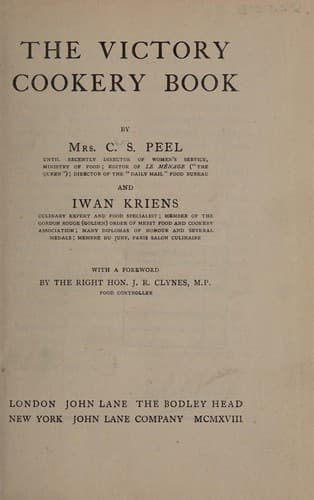
The victory cookery book
1918Peel, C. S. Mrs · 70 readable pages · 253 recipe records · wartime household cookery and food economy manual
From the librarian's dossier · AI-generated, grounded in the scanned text
The Victory Cookery Book is a British wartime cookery manual by Mrs. C. S. Peel, published in 1918 during the final year of the First World War. It is a practical guide to feeding a household under conditions of rationing, food scarcity, and fuel shortage. Rather than a book of indulgent recipes, it is a manual of resourcefulness, teaching cooks how to stretch scarce meat, fat, sugar, and eggs while still producing nourishing meals. The book opens with nutritional theory, explaining the components of food and how cooking methods affect their preservation, then moves through soups, sauces, fish, meatless dishes built on pulses and cereals, vegetable preparations, and pastry and puddings adapted to restricted ingredients. It closes with technical notes on stocks, batters, fats, and even invalid cookery and packed lunches. Throughout, the author's voice is didactic and economical, urging readers toward substitution, waste reduction, and fuel-conscious methods like steaming rather than boiling. Modern readers will find it a vivid document of home-front austerity, showing how an ordinary household cook was expected to reconcile nutrition, flavor, and patriotic thrift. It offers both a historical window into 1918 British diet and a set of recipes that, while shaped by scarcity, remain intelligible as cooking instructions today.
The book is organized into numbered chapters that move from general principles to specific categories of dishes. It begins with general notes on food value and preparation (section 1), followed by sauces and fish cookery (section 2). A gap in the provided sections suggests intervening material not covered here, before the book resumes with meatless dishes built on cereals and pulses (section 4), vegetable dishes and the beginnings of pastry and puddings (section 5), and finally a chapter of miscellaneous techniques covering stocks, batters, fats, invalid cookery, and packed lunches, closing with an index (section 7). Chapters are further broken into headed subsections, such as individual vegetables or sauce types, each followed by short recipes.
Recipes from this book
253 records extracted from the text, showing the first 50 in reading order. Each links to a modern interpretation.
Read the book
70 readable pages. A dot marks pages with recipe records.