
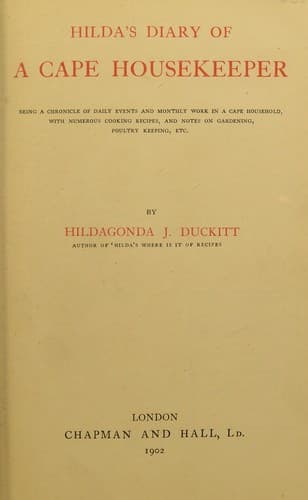
Hilda's diary of a Cape housekeeper
1902Hildagonda J. Duckitt · 121 readable pages · 219 recipe records · seasonal household diary and cookbook
From the librarian's dossier · AI-generated, grounded in the scanned text
Hilda's Diary of a Cape Housekeeper is a 1902 household chronicle by Hildagonda J. Duckitt, presenting farm and domestic life at the Cape of Good Hope in South Africa through a diary-like, month-by-month structure. Rooted in the author's family history at Groote Poste and her experiences at Wynberg near Cape Town, the book blends personal memoir, seasonal farm management, and practical cookery. Readers follow the agricultural and social calendar from January through December, encountering recipes for preserves, baked goods, meats, fish, and puddings alongside guidance on servants, wages, poultry keeping, gardening, water supply, and even camping and picnicking excursions. The text captures the blended English and Dutch colonial culture of the Western Province, with attention to self-sufficiency, hospitality, and regional produce such as snoek, guavas, mebos, and Cape gooseberries. Beyond recipes, the book includes home remedies, invalid cookery, nursing advice, and an appendix on Cape fish, locust control, and humane slaughter methods. It closes, somewhat incongruously to modern eyes, with publisher's advertisements for Dickens editions. This is as much a social document of colonial farm life as a cookbook, offering readers a layered view of household economy, seasonal rhythm, and community correspondence in early twentieth-century Cape Colony.
The book is organized as a diary moving through the calendar year, with sections corresponding roughly to months from January through December. Early sections establish family and estate history before shifting into practical household chapters on servants, laundry, fuel, baking, and poultry. Recipes and seasonal produce notes are interwoven with narrative diary entries throughout the months, and specialty chapters address preserving, camping and picnicking, and Christmas preparations. The book closes with a substantial appendix covering Cape fish names, locust destruction methods, humane animal killing, home remedies, invalid cookery, nursing hints, and household hints, followed by unrelated publisher's advertisements for Dickens editions in the final section.
Recipes from this book
219 records extracted from the text, showing the first 50 in reading order. Each links to a modern interpretation.
Read the book
121 readable pages. A dot marks pages with recipe records.