
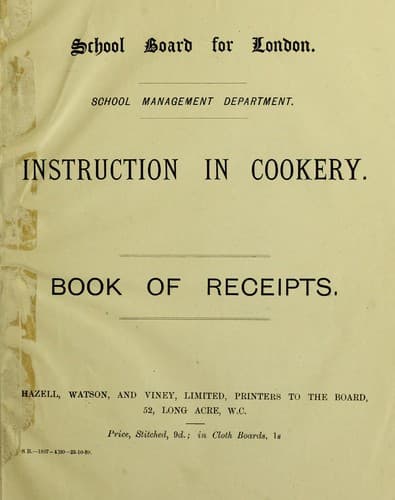
Instruction in cookery (London School Board receipts)
1890London (England). School Board · 26 readable pages · 121 recipe records · household cookery instruction manual
From the librarian's dossier · AI-generated, grounded in the scanned text
This is a cookery instruction manual produced by the London School Board in 1890, designed to teach basic, economical household cooking to working-class families in Victorian England. Rather than a chef's showcase, it is a practical teaching text, likely used in board schools to instruct girls and young women in domestic skills that would serve their own households. The recipes cover everyday fare: stews, boiled and roasted meats, fish, soups, vegetables, breads, cakes, puddings, preserves, and simple beverages. Precision is a hallmark of the book, with careful attention to measurements, timing, and technique, reflecting a systematic pedagogical approach rather than culinary artistry. The dishes emphasize thrift, using affordable cuts of meat, preserved foods, and staple vegetables like the potato, which receives extensive treatment across multiple cooking methods. For the modern reader, this book offers a window into how nutrition and domestic economy were taught to poorer households in late Victorian London, blending practical skill-building with an implicit social mission to improve health and household management among the working class. It is not a book of luxury or novelty, but one of necessity and instruction.
The book is organized into three mechanically gated sections that move from savory main dishes to starches and baked goods, then to a miscellany of breakfast items, preserves, and condiments. Section 1 focuses on meat and fish dishes along with soups and vegetables. Section 2 concentrates heavily on potatoes prepared multiple ways, followed by bread, cakes, and a range of boiled and baked puddings. Section 3 rounds out the book with biscuits, breakfast dishes, sauces, jams, beverages, pickles, salads, and specialty preparations like barley water and savoury pudding. The organization suggests a course of instruction moving through categories of daily household cooking rather than a strict alphabetical or menu-based structure.
Recipes from this book
121 records extracted from the text, showing the first 50 in reading order. Each links to a modern interpretation.
Read the book
26 readable pages. A dot marks pages with recipe records.