
What to Have for Dinner
1905Fannie Merritt Farmer · 72 readable pages · 418 recipe records · menu-based household cookbook
From the librarian's dossier · AI-generated, grounded in the scanned text
Published in 1905 by Fannie Merritt Farmer, one of the era's most influential American cooking authorities, What to Have for Dinner tackles a practical daily problem: deciding what to serve and how to prepare it, course by course. Rather than an alphabetical reference, the book is organized around complete dinner menus, each paired with the recipes needed to execute it, ranging from simple family suppers to elaborate holiday feasts and formal company entertaining. Readers move through everyday fare like roast chicken and braised beef into more festive Thanksgiving, Christmas, and Easter spreads, then into warm weather menus, emergency dinners built on shelf-stable goods, and finally showcases of upper-class formal dining featuring aspics, sweetbreads, and elaborate molded desserts. Throughout, Farmer pairs practical technique (roasting, braising, steaming, sauce-making) with an eye toward presentation and course progression. With 418 anchored food records, the book functions as both a menu-planning guide and a substantial recipe collection, closing with an extensive index for cross-referencing dishes. It offers modern readers a detailed window into how an educated, middle-to-upper-class American household approached the daily and ceremonial business of dinner at the turn of the twentieth century.
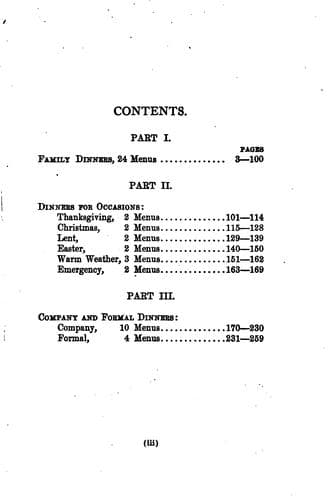
The book is arranged as a sequence of complete dinner menus rather than an alphabetical list of recipes. It opens with Part I, Family Dinners (sections 1 through 3), offering ten or more everyday menus each followed by the recipes required to prepare every course. This moves into Dinners for Occasions (sections 3 and 4), covering Thanksgiving, Christmas, Lenten, and Easter meals. Section 5 groups menus by circumstance: warm weather dinners, emergency dinners for unexpected guests, and the opening of Part III, Company and Formal Dinners. Sections 5 through 7 continue this formal entertaining section with increasingly elaborate multi-course menus featuring French-influenced dishes, sophisticated sauces, and molded desserts. Section 8 closes the book with finishing recipes and an extensive recipe index spanning from almonds to wine sauces, allowing readers to locate specific preparations across the whole volume.
Recipes from this book
418 records extracted from the text, showing the first 50 in reading order. Each links to a modern interpretation.
Read the book
72 readable pages. A dot marks pages with recipe records.