
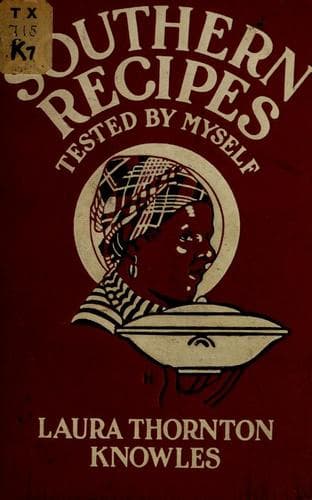
Southern Recipes
1913Laura Thornton Knowles · 16 readable pages · 103 recipe records · regional Southern household cookbook
From the librarian's dossier · AI-generated, grounded in the scanned text
Southern Recipes (1913) by Laura Thornton Knowles is an early twentieth-century American cookbook devoted to Southern and Creole-influenced cooking. Drawing on 103 anchored food records, the book presents a substantial collection of soups, fish dishes, meats, vegetables, pickles, preserves, and breads that together sketch the culinary world of the Southern kitchen in the Victorian-to-Progressive Era transition. Readers will find recipes for gumbo file, okra gumbo, barbecued pig, Brunswick stew, and crab jambalaya alongside more genteel dishes like spinach soup and rice crustades, reflecting a cuisine that blends African, French Creole, and Anglo-American traditions. The book opens with a title page, preface, and detailed table of contents before moving into its recipe sections, which are organized by category rather than by meal or occasion. Instructions are precise for their time, offering measurements and step-by-step guidance on seasoning, layering, and timing. For the modern reader, this book offers a window into how Southern regional cooking was codified and presented to a broader American audience in the early 1900s, at a moment when cookbook authors were increasingly systematizing traditional recipes for domestic reference use.
The book is organized as a single continuous sequence beginning with digitization and publication front matter (title page, preface, table of contents), followed by recipes grouped into clear categories: soups, fish dishes, meats, vegetables, pickles and preserves, and breads. Section 1 covers pages 0 through 9 and contains this full arc from front matter into the early recipe categories, suggesting the book relies on a category-based table of contents to guide readers to specific dish types rather than organizing by menu, season, or course.
Recipes from this book
103 records extracted from the text, showing the first 50 in reading order. Each links to a modern interpretation.
Read the book
16 readable pages. A dot marks pages with recipe records.