
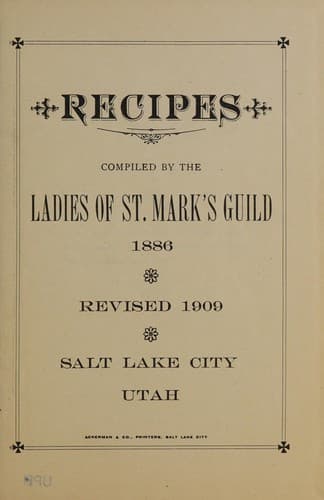
Recipes compiled by the ladies of St. Mark's Guild, 1886, revised 1909
1909Utah) St. Mark's Guild (Salt Lake City · 44 readable pages · 244 recipe records · community fundraising household cookbook
From the librarian's dossier · AI-generated, grounded in the scanned text
This is a community fundraising cookbook compiled by the ladies of St. Mark's Guild in Salt Lake City, Utah, originally issued in 1886 and revised in 1909. It belongs to the well-known American tradition of charitable club cookbooks, in which women's church or civic organizations pooled tested household recipes, often crediting individual contributors by name, and sold the resulting volume to support their work. The book moves through the full arc of a formal American household's cooking needs of its era, from soups and seafood through entrees, vegetables, salads, desserts, baked goods, preserves, candies, beverages, and finally practical kitchen notes including gas stove instructions and a measurement table. With 244 anchored food records across its five sections, it offers a dense, practical snapshot of turn-of-the-century domestic cookery in the American West. Readers today will find it valuable both as a working recipe collection and as a social document, since many entries carry the names of the women who submitted them, revealing a network of household expertise and community identity. The revision date of 1909 also places it at a moment of transition in kitchen technology, evidenced by its attention to gas stove cooking alongside older stovetop and oven methods.
The book is organized into five sections that follow a traditional courses-based household cookbook sequence. Section 1 opens with soups and seafood before moving into entrees, luncheon dishes, and vegetable cooking instructions. Section 2 continues vegetables and salads before shifting into an extensive dessert section covering puddings, pudding sauces, and frozen desserts. Section 3 continues desserts with ices, frostings, cakes, pastries, and cookies. Section 4 covers baked goods such as cookies, cakes, breads, and muffins, then transitions into pickling, relishes, and fruit preserves. Section 5 closes the book with candies, beverages, gas stove cooking tips, sundries, and a measurement conversion table. Headings throughout are recipe-specific and often named for a contributor or a distinctive dish title rather than organized under broad category headers alone.
Recipes from this book
244 records extracted from the text, showing the first 50 in reading order. Each links to a modern interpretation.
Read the book
44 readable pages. A dot marks pages with recipe records.