
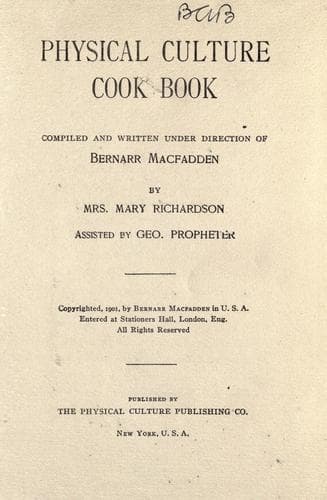
Physical culture cook book
1901Richardson, Mary Mrs. · 74 readable pages · 443 recipe records · general household cookbook with health reform philosophy
From the librarian's dossier · AI-generated, grounded in the scanned text
The Physical Culture Cook Book (1901) was compiled by Mary Richardson under the direction of Bernarr MacFadden, the era's leading advocate of physical culture and natural health. Far from a conventional collection of recipes, this book presents cooking as a tool of public health reform, arguing in its preface that improperly prepared food was a major cause of illness while wholesome, simply seasoned meals could strengthen both body and mind. Drawing on sample menus from a Physical Culture Health Home, the text favors whole grains, minimal seasoning, and reduced meat consumption, while still covering the full range of dishes expected in an American household manual, from breads and vegetables to meats, poultry, sauces, desserts, and preserves. With 443 anchored food records, this is a substantial and detailed working cookbook, but its editorial voice sets it apart, weaving nutritional commentary and moral argument for simpler eating through nearly every chapter. Modern readers will find it a fascinating window into Progressive Era health reform movements as expressed through the American kitchen, blending practical instruction with an outspoken philosophy of dietary discipline.
The book is organized into numbered chapters that move from foundational principles to specific food categories. It opens with a preface and philosophical introduction (section 1), followed by chapters on whole grain preparation, special cooking instructions, and an extensive bread section. Subsequent chapters proceed through breakfast breads and vegetables (section 2), soups, fish, and shellfish, and the start of meat cookery (section 3), continuing meats, poultry, game, sauces, cheese, and eggs (section 4). A gap in the provided material skips ahead to desserts, covering puddings, custards, jellies, frozen desserts, and pies (section 6), before concluding with pastries, an extensive cakes chapter, and canning and preserving (section 7). The organization follows a fairly conventional household cookbook sequence, but each chapter is prefaced with nutritional or physiological reasoning consistent with the book's health reform mission.
Recipes from this book
443 records extracted from the text, showing the first 50 in reading order. Each links to a modern interpretation.
Read the book
74 readable pages. A dot marks pages with recipe records.